
Math help for parents
Short, practical guides for helping children aged 4 to 8 with math at home: what to expect at each age, how to explain an idea, and games that make practice fun.
 Teaching math
Even and odd numbers: the pairing trick for kids
A number is even if objects split into pairs with none left over. Teach even and odd numbers with pairs first, then skip counting and the last-digit rule.
 Teaching math
Fact family in math: what it means and how to teach it at home
A fact family is the set of addition and subtraction facts that use the same three numbers. See fact triangles, examples and how they make subtraction easier.
 Teaching math
Greater than less than: how to teach the symbols to kids
Greater than, less than and equal to start with comparing objects. Steps for teaching the > and < symbols, and what the alligator trick can and can't do.
 Teaching math
Counting coins: how to teach kids to count money
Counting coins starts with the value of each US coin, then biggest first and counting on. See the steps, a worked example and making change by counting up.
 Teaching math
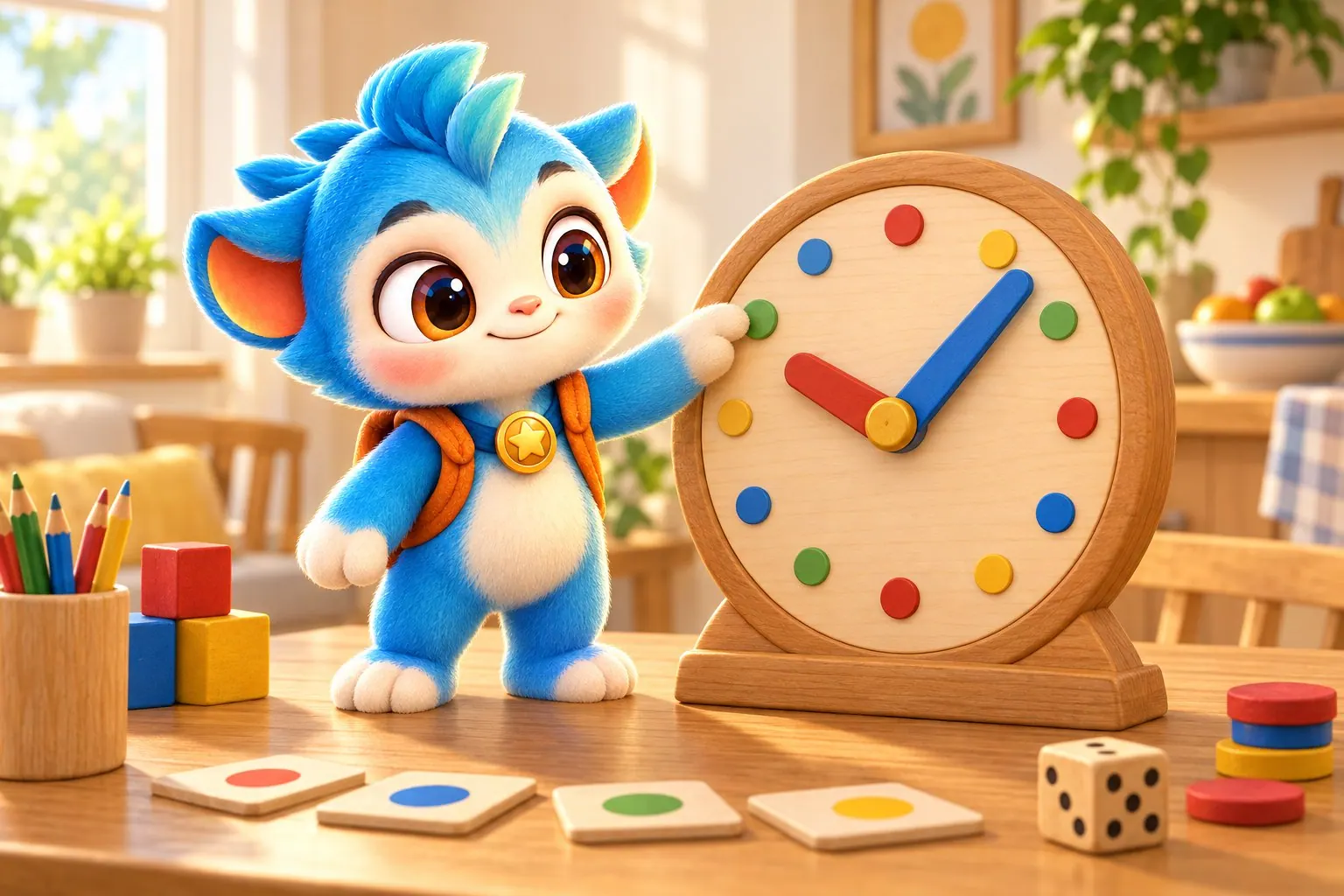
How to read a clock: teaching a child to tell time step by step
How to read a clock and teach it to a child: hour hand first, then half past, quarter past and quarter to, five-minute steps, and analog versus digital.
 Teaching math
How to teach a child to count: 6 steps for ages 3 to 5
Counting is more than saying numbers in order. Six steps with household objects that take a child from reciting to counting a group and saying how many.
 Teaching math
How to teach addition: from counting all to making ten
How to teach addition to kids in order: counting all, counting on, doubles, making ten, then fluency through play instead of timed drills.
 Teaching math
How to teach multiplication: groups, arrays, then facts
How to teach multiplication in a sensible order: equal groups, repeated addition, skip counting and arrays first, then the facts for 2, 5 and 10.
 Teaching math
How to teach subtraction so it makes sense to your child
Teach subtraction in a sensible order: taking away, counting back on a number line, finding the difference and thinking addition. With common mix-ups.
 Games and activities
Math board games for kids: what to play at ages 3 to 8
Math board games for kids, by age: race tracks, dominoes, sowing games, Shut the Box and dice games, plus how to make your own number track at home.
 Games and activities
Math card games for kids: 7 games with one ordinary deck
Seven math card games for kids that use one regular deck. Short rules, an age for each game, and the math each one practices, from number order to making ten.
 Games and activities
12 math games for kids at home, with no worksheets
Twelve math games for kids at home using cards, dice, the kitchen and a walk. No worksheets, no special supplies, plus free online games to try.
 Teaching math
Number bonds to 10: what they are and 7 ways to practice
Number bonds to 10 are the pairs that make 10, like 3 and 7. See what they are, why making ten matters, and seven ways to practice at home.
 Teaching math
One to one correspondence: what it is and how to teach it
One to one correspondence means one number word for each object you count. See how it develops, activities for home, and the signs that it is clicking.
 Teaching math
Place value: teaching tens and ones with things at home
Place value means a digit's position gives its worth. See how to teach tens and ones with bundles, why 14 is ten and four, and the mix-ups to expect.
 Teaching math
Skip counting by 2s, 5s and 10s: a parent's guide with a chart
Skip counting means counting in equal jumps. Learn how to teach counting by 10s, 5s and 2s, how to use a hundred chart, and how it leads to multiplication.
 Teaching math
Subitizing: how to help kids see how many at a glance
Subitizing means seeing how many without counting. Learn the two kinds, why dice and dot patterns work, and how to practice with fingers and ten frames.
 Math by age
What math should a 5-year-old know? A parent's checklist
A range-based checklist of the math many 5-year-olds are working on, signs your child is ready for more, and everyday ways to practice at home.