
Games and activities
Math board games for kids: what to play at ages 3 to 8
In this guide
- Do board games help kids learn math?
- What makes a board game good for math?
- Which math board games suit ages 3 to 4?
- Which games suit ages 5 to 6?
- Which games suit ages 7 to 8?
- How do you play dominoes, Shut the Box and a sowing game?
- Which math dice games are worth playing?
- How do I make my own number track?
- Which free games go with these?
- Quick answers
Math board games work best when they use numbers: a numbered path, dice, or counters to count. At ages 3 to 4, try a short race track and one die. At 5 to 6, add dominoes and longer tracks. At 7 to 8, try Shut the Box, sowing games and two dice.
Do board games help kids learn math?
Some do. In a 2008 study, Siegler and Ramani had preschoolers from low-income families play a simple numerical board game for four 15-minute sessions. They report that this “eliminated the differences in numerical estimation proficiency” that separated these children from more affluent peers, and that “playing games that substituted colors for numbers did not have this effect.”
The IES practice guide for teaching math to young children reports a similar pattern: children who played number-based board games did better on basic number concepts than children who played color-based board games or none. It adds that the effects on number recognition and operations “were mixed.” The guide covers preschool through kindergarten. Games are part of a recommendation it rates as having minimal evidence, which it explains as meaning its panel could not point to research showing a positive effect on achievement.
So a number game is a reasonable way to practice counting at home, though neither source promises results. Pick games with numbers on them: in the study, the color version did not have the same effect.
What makes a board game good for math?
The studies compare number games with color games, so only the first feature below has research behind it. The rest are our suggestions.
- The spaces are numbered.
- A child says a number for each space as they move.
- Moves are decided by counting: a die, or counting the dots on a spinner.
- The path is straight, so bigger numbers are farther along, like the “linear” games in the 2008 study’s title.
- Play is short enough to finish in one sitting.
The IES guide describes a way to grow a game with the child: start with a color-coded spinner that matches colored spaces, then use a spinner with dots, then numerals. Children can “rely on color” first, later “count the dots,” and finally “use numerals to play the game.”
Which math board games suit ages 3 to 4?
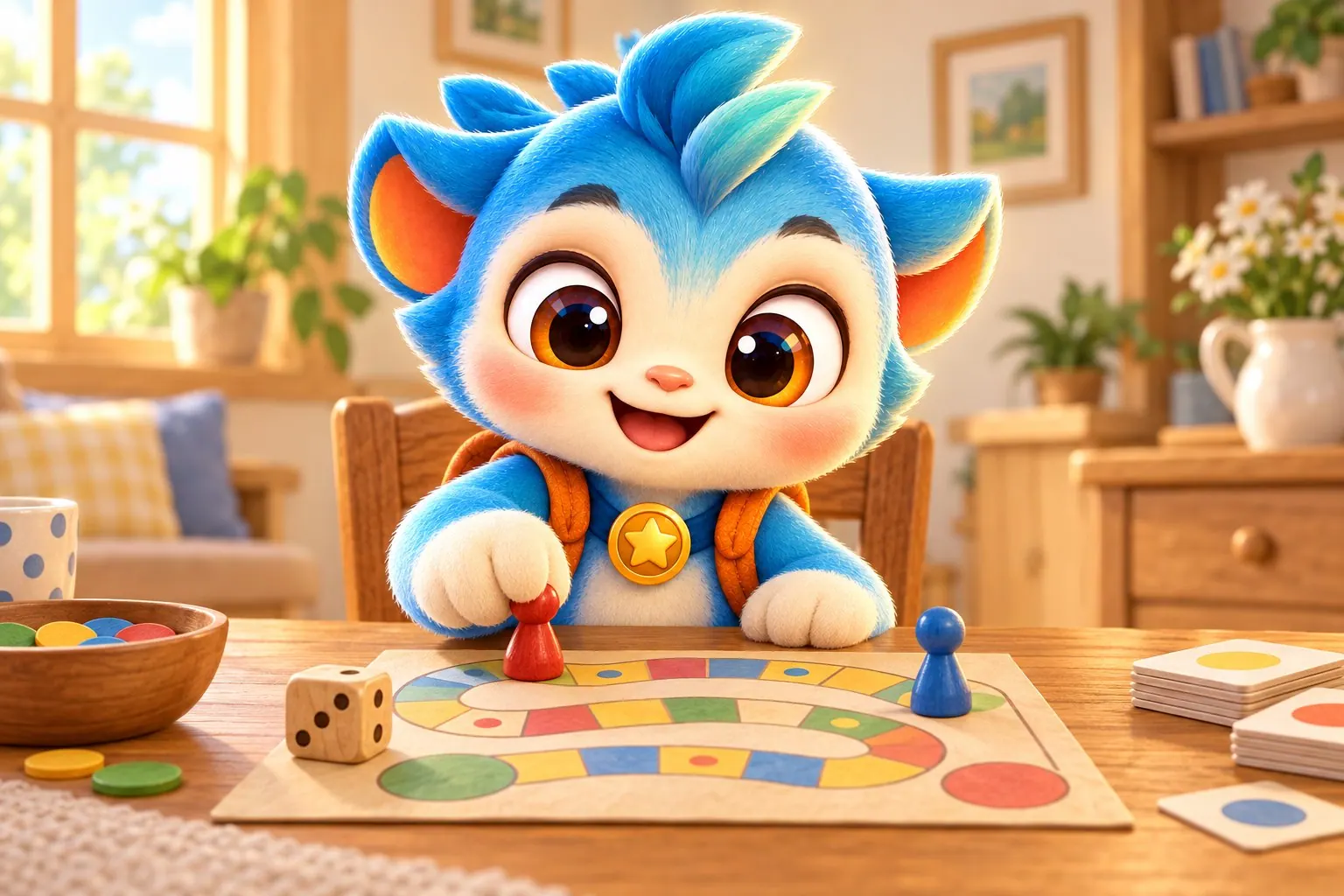
A race game gives a child a reason to count one space at a time.
- A short race track. Roll one die, move that many spaces and count each space aloud. Moving a piece onto a space and saying one number for it is the same pairing you use for counting objects. Our guide to one to one correspondence explains why that matters. The homemade number track below is a good first board.
- A color path. Color the spaces in a repeating pattern and make a few color cards. Draw a card and move to the next space of that color. This takes the numbers out at first, as the IES guide describes, and you can add dots and then numerals.
Use big, easy-to-hold pieces. Dice, pawns and counters are small parts, so keep them away from children under 3 and stay close with older toddlers. Large foam dice are easier to hold.
Which games suit ages 5 to 6?
- A longer track to 20 or 30. After a roll, count on from where you are: “I’m on 7 and rolled a 4: 8, 9, 10, 11.” The kindergarten standards ask children to count forward “beginning from a given number within the known sequence (instead of having to begin at 1),” and Grade 1 relates counting to addition, “e.g., by counting on 2 to add 2.”
- Dominoes. Each tile has two halves with dots, and matching halves is the whole game. The rules are below. Ask your child how many dots are on each half and how many in all. Younger children can count the dots one by one.
- Matching games with number cards. See math card games for seven you can play with one deck.
Which games suit ages 7 to 8?
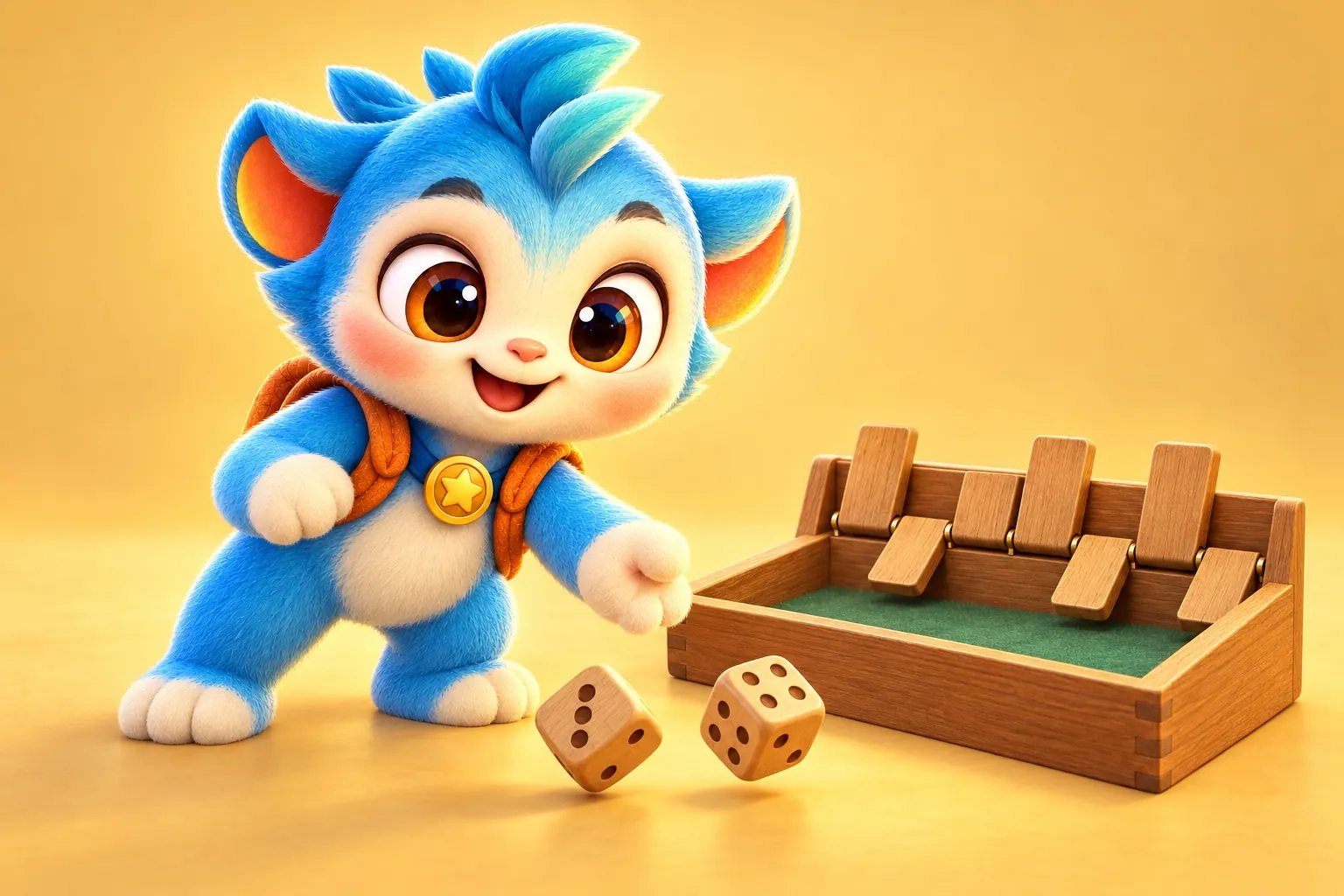
- Shut the Box. Two dice and nine numbered tiles: each roll is an adding problem with more than one answer. The rules are below.
- A sowing game. Players move counters around a row of cups, dropping one in each cup and counting aloud. An egg carton is enough. The rules are below.
- A race against the computer. In our free River Race, you race Mathumo, the character from our games, down a 12-step river. Each turn you tap the answer to a two-digit sum, adding or taking away (you pick which). An answer right the first time moves your boat two steps, and an answer after a miss moves it one. The other boat moves one step every turn.
Grade 2 asks children to “fluently add and subtract within 20 using mental strategies.” The dice games further down give practice with small sums and differences.
How do you play dominoes, Shut the Box and a sowing game?
These are classic games with many versions. Here is one simple set of rules for each.
Dominoes (ages 5 and up)
- Use a set whose halves go up to six dots (28 tiles). Turn the tiles face down and mix them.
- With two players, each takes seven tiles. Leave the rest face down to draw from.
- The youngest player puts down any tile.
- Take turns adding one tile to either open end of the line. The two halves that touch must have the same number of dots.
- If you can’t play, draw tiles until you can. If none are left to draw, pass.
- The first player to put down all their tiles wins. If no one can play, each player counts the dots on the tiles they still hold, and fewer dots wins.
Shut the Box (ages 7 to 8)
- Write 1 to 9 on nine paper squares and lay them in a row, number side up.
- Roll two dice and add them.
- Turn over open squares that add up to the total. For 8, you could turn over 8, or 3 and 5, or 1, 2 and 5.
- Keep rolling until you roll a total that the open squares can’t make.
- Add the numbers still showing. Lower is better, and if you turned over every square, you shut the box.
- With two or more players, each takes a turn like this, and the lowest total wins.
Our free Shut the Box game plays the same way for one player, and its one-die Little Box, with tiles 1 to 6, suits beginners.
A sowing game (ages 7 to 8)
- Put an egg carton with 12 cups between two players, long sides facing them. The six cups nearest you are yours. Put a bowl at each end: your store is the bowl on your right.
- Put four dry beans in each cup.
- On your turn, scoop up all the beans in one of your cups. Moving to your right and around the carton, drop one bean in each cup that follows, counting aloud. Drop one in your own store as you pass it, but skip the other player’s store.
- If your last bean lands in your store, take another turn.
- The game ends when all six cups on one side are empty. Each player puts the beans left on their side into their own store.
- Count the beans in each store. More beans wins.
Dry beans are a choking risk, so play this only with older children and keep the beans away from anyone under 3.
Which math dice games are worth playing?
Each of these needs one or two dice, and some need counters or a pencil and paper. Dice and counters are small parts, so keep them away from children under 3.
- Roll and hop (ages 3 to 5). Roll one die. Hop, clap or stomp that many times while your child counts, then swap who rolls. The IES guide suggests counting actions as well as objects.
- Higher number wins (ages 4 to 6). Each player rolls one die. The higher roll wins a counter; if the rolls match, roll again. Ask, “How do you know whose is more?” Children may count the dots or just see which is bigger. The first player to win 10 counters wins.
- Three-roll total (ages 6 to 8). On your turn, roll two dice and write down the total. Roll twice more, adding each roll to your total. When everyone has had a turn, the highest total wins. Counting on from the total so far is the strategy to practice.
- The difference game (ages 6 to 8). Take turns rolling two dice. Subtract the smaller number from the larger and take that many counters. After five turns each, whoever has more counters wins. “How many more is 6 than 2?” is a subtraction question: comparing is one of the situations the US Grade 1 and Grade 2 standards list for addition and subtraction word problems.
How do I make my own number track?
You need paper, a pen, one die and a small figure for each player, such as a toy animal or a button. Small toys and buttons are choking risks for children under 3, so use bigger pieces if a toddler is playing or nearby.
- Draw ten squares in a straight line, all the same size. Tape two sheets together if you want more.
- Number the squares 1 to 10, in order, left to right. Square 1 is the start and square 10 is the finish.
- Put every player’s figure on square 1.
- Take turns rolling the die and moving that many squares. Count aloud as you move, one number for each square. Older children can say the square numbers instead: from 3, a roll of 2 is “4, 5.”
- The first player to reach or pass square 10 wins.
- When 10 feels easy, add squares up to 20 or 30. Add a few special squares such as “Move back 2” for subtraction.
For the youngest players, use the color path above on the same squares, then swap to a die later. For the oldest, use a track up to 100 and two dice.
Which free games go with these?
The free Count and Tap game practices one-to-one counting, with groups of up to 5, 10 or 20 objects. For what each grade covers, see the kindergarten and first grade pages. Our wider list of math games for kids at home adds kitchen and walking games.
Quick answers
Do board games help kids learn math?
Some do. In one study, preschoolers from low-income families who played a simple numerical board game for four 15-minute sessions caught up with more affluent peers on numerical estimation, and a version with colors instead of numbers did not have that effect. The IES practice guide reports better results on basic number concepts too, mixed results on number recognition and operations, and rates the evidence for its games recommendation as minimal.
What are the best board games for a 3-year-old?
Look for a short path with one die and big, easy pieces. Count each space aloud as you move, one number for each space. A color-matching path game is a good start before numbers. Keep dice and small pieces away from children under 3, who may put them in their mouths.
What are some dice games that teach math?
Roll and hop for counting, higher number wins for comparing, a three-roll total for adding, and the difference game for subtracting. Each needs only one or two dice, plus counters or a pencil and paper.
How do I make a number track?
Draw or tape ten equal squares in a straight line, number them 1 to 10 in order, and put a small figure for each player on square 1. Roll one die, move that many squares and count each one aloud. Extend the track to 20 or 30 when 10 feels easy.
How often should we play?
A game or two a week, kept short, is a good start, and stop while your child still wants more. That is our suggestion; in the 2008 study, the children played four 15-minute sessions.
Related
Shut the Box
Roll the dice, then close tiles that add up to the roll. Can you close them all?
- Ages 5–8
- Addition within 12
- Number bonds

River Race
Paddle against Mathumo: each right answer moves your boat forward.
- Ages 6–8
- Two-digit addition
- Two-digit subtraction

Count and Tap
Tap each bug once to count it, then say how many.
- Ages 3–6
- Counting to 20
- One-to-one counting
Sources
- Playing linear numerical board games promotes low-income children's numerical development, Siegler and Ramani, Developmental Science, 2008 (PubMed record). pubmed.ncbi.nlm.nih.gov
- Teaching Math to Young Children (practice guide), US Institute of Education Sciences, What Works Clearinghouse. ies.ed.gov
- Common Core State Standards for Mathematics, Kindergarten: Counting and Cardinality (K.CC), National Governors Association Center for Best Practices and Council of Chief State School Officers. www.thecorestandards.org
- Common Core State Standards for Mathematics, Grade 1: Operations and Algebraic Thinking (1.OA), National Governors Association Center for Best Practices and Council of Chief State School Officers. www.thecorestandards.org
- Common Core State Standards for Mathematics, Grade 2: Operations and Algebraic Thinking (2.OA), National Governors Association Center for Best Practices and Council of Chief State School Officers. www.thecorestandards.org
Keep reading
12 math games for kids at home, with no worksheets
Twelve math games for kids at home using cards, dice, the kitchen and a walk. No worksheets, no special supplies, plus free online games to try.
Math card games for kids: 7 games with one ordinary deck
Seven math card games for kids that use one regular deck. Short rules, an age for each game, and the math each one practices, from number order to making ten.

Greater than less than: how to teach the symbols to kids
Greater than, less than and equal to start with comparing objects. Steps for teaching the > and < symbols, and what the alligator trick can and can't do.