
Preschool math for ages 4 to 5
Ages 4–5 · US Preschool · England Reception
At ages 4 to 5, children learn to count small groups one by one, recognise numbers to 10, compare which group has more, spot simple patterns and name flat and solid shapes. Mathumo teaches each idea with objects first, then pictures, and only then with numerals.
What children learn, unit by unit
Counting to 5
- Matching one to one
- Seeing 1 to 3 at a glance
- Counting objects to 5
- The last number counted tells how many
- Numerals 0 to 5
Sorting and patterns
- Sorting by colour, size or shape
- AB patterns, then AAB, ABB and ABC
- Sorting into groups and counting them
More, fewer and together
- Comparing groups to 5
- One more and one less
- Putting together and taking apart within 5
- Finding a missing part
Shapes and places
- Circle, square, triangle, rectangle
- Position words: above, below, beside
- Sides and corners
- Spheres, cubes, cylinders and cones
Counting to 10
- Counting to 10, then to 20
- Seeing 1 to 5 at a glance
- Numerals 0 to 10
- Comparing groups to 10
- First to fifth
Big, heavy and full
- Comparing length, weight and capacity
- First, next and last
Inside 10
- Splitting numbers to 10
- Adding and taking away within 5
- Doubles to 5 + 5
- Odd and even by pairing
- Sharing fairly
Standards it covers
- Head Start ELOF Counting and cardinality, operations and algebraic thinking, measurement and data, geometry and spatial sense (preschool goals).
Mathumo is built on US standards: Common Core (K–2) and Head Start (Preschool). No endorsement by those bodies is implied.
How Mathumo teaches it
Hands-on boards instead of multiple choice:
- Counting by touch, one object at a time
- Ten frames
- Part–whole mats
- Pattern building
- Shape building
Free games for this age
Count and Tap
Tap each bug once to count it, then say how many.
- Ages 3–6
- Counting to 20
- One-to-one counting

Number Path
Help Mathumo cross the stones by stepping on the numbers in order.
- Ages 4–6
- Number order to 20
- Reading numerals

Shape Pop
Pop the bubbles that hold the shape Mathumo asks for.
- Ages 3–6
- Naming 2-D shapes
- Sides and corners
Sudoku for Kids
Shape and number puzzles with one answer each.
- Ages 4–8
- Logical thinking
- Shapes and numbers 1 to 6
Guides for parents
Practical help for teaching preschool math at home.
How to teach a child to count: 6 steps for ages 3 to 5
Counting is more than saying numbers in order. Six steps with household objects that take a child from reciting to counting a group and saying how many.
Math board games for kids: what to play at ages 3 to 8
Math board games for kids, by age: race tracks, dominoes, sowing games, Shut the Box and dice games, plus how to make your own number track at home.
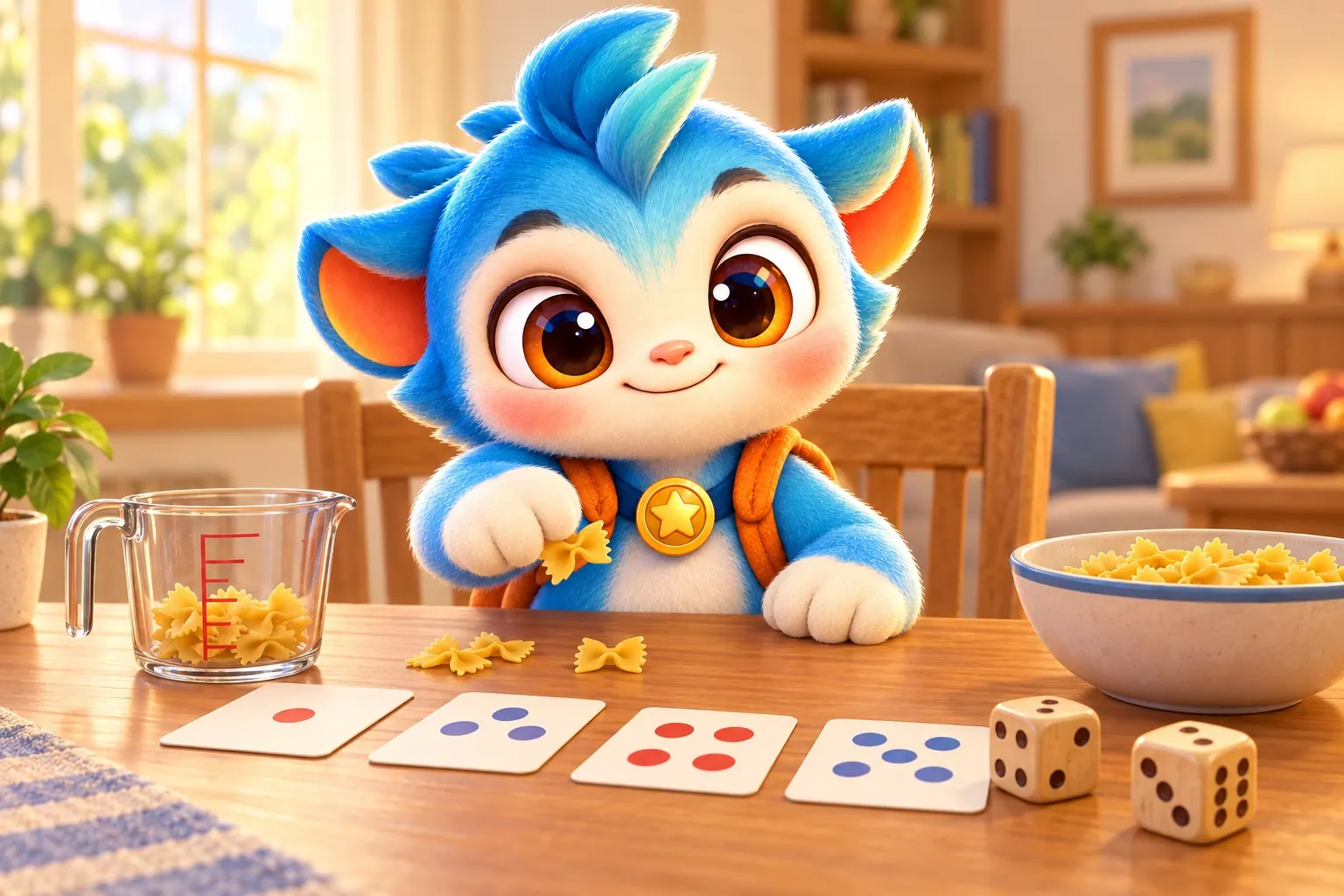
12 math games for kids at home, with no worksheets
Twelve math games for kids at home using cards, dice, the kitchen and a walk. No worksheets, no special supplies, plus free online games to try.
Questions parents ask
What math should a 4-year-old know?
Most 4-year-olds are learning to count a small group by touching each object once, to say how many after counting, and to compare two small groups. Recognising numerals to 5 or 10 and naming a few shapes usually comes during this year. Children vary a lot at this age, so the order matters more than the date.
Is my child ready for a math app at 4?
Mathumo starts at age 4 with short sessions of 5 to 15 minutes, chosen by a parent. A short placement at the start finds where your child is, and age is only a first guess: no child is ever labelled as behind.
What are the preschool math standards?
Head Start describes preschool math in its Early Learning Outcomes Framework, with goals for counting and cardinality, operations and algebraic thinking, measurement and data, and geometry and spatial sense. Mathumo’s preschool section, often called pre-K math, is built on those goals. No endorsement by Head Start is implied.