
Teaching math
One to one correspondence: what it is and how to teach it
In this guide
- What does one to one correspondence mean?
- How does it develop?
- How do we practice touch and count?
- What happens when we line up, then scatter?
- How can we move each counted object aside?
- Which one-for-each games work without counting?
- What do mix-ups sound like?
- What are the signs it is clicking?
- Which games help with one to one counting?
- Quick answers
One to one correspondence means matching one number word to exactly one object as you count, so nothing is skipped and nothing is counted twice. It is how counting works. Children practice it by touching or moving each object while they say each number, usually with small groups first.
What does one to one correspondence mean?
When you count four pennies, you point to a penny and say “one,” point to a second penny and say “two,” and carry on until each penny has had one word. The US kindergarten standard K.CC.B.4.a puts it this way: pair “each object with one and only one number name and each number name with one and only one object.”
Your child has to do two jobs at once: say the words in order, and land each word on a new object. In the IES practice guide’s words, the child “will need to keep track of which pennies have been labeled and which still need to be labeled.” That tracking takes practice, so start with a group of three or four.
The phrase has a second, everyday meaning: pairing things without counting, such as one spoon beside each bowl. The kindergarten standards mention “matching and counting strategies” for deciding whether one group has more than another.
How does it develop?
Reciting the numbers and matching them to objects are separate skills. Children often begin by reciting the count sequence, the IES guide says, and assigning the numbers to a collection of objects “can be a challenging step.” The Head Start framework lays out a progression under Goal P-MATH 3, “Child understands the relationship between numbers and quantities”:
- Between 36 and 48 months (ages 3 to 4), a child “begins to coordinate verbal counting with objects by pointing to or moving objects for small groups of objects laid in a line.”
- Between 48 and 60 months (ages 4 to 5), a child “may point to or move objects while counting objects to 10 and beyond.”
- By 60 months, the framework expects a child to pair one number word with one object up to at least 10, and to accurately count as many as 5 objects in a scattered configuration.
In US kindergarten, standard K.CC.B.5 goes further: count to answer “how many?” about as many as 20 things in a line, a rectangular array or a circle, or as many as 10 scattered. These are goals for the end of a stage, and children reach them at different times.
How do we practice touch and count?
Use 3 to 5 objects, such as spoons, blocks or toy cars. If a child under 3 is nearby, pick things too big to fit in a mouth.
- Line them up in front of your child.
- Count together, slowly. Touch one object for each word.
- Say the last number again, a little louder: “Four. There are four cars.”
- Count a new group of a different size tomorrow.
If your child is just starting, the IES guide suggests modeling with one to three items and repeating the last number word. If your child says the words faster than they touch, slow down and guide their hand for the first few counts.
What happens when we line up, then scatter?
A line shows where to start and where to stop. A pile does not, so keep the line first and spread the objects out in steps.
- Count four blocks in a line.
- Push them into a loose cluster and ask, “How many now?”
- Let your child count again. They should get four.
- Scatter them a little more and ask again.
The kindergarten standards say the count “is the same regardless of their arrangement or the order in which they were counted.” Order works the same way. A line of blocks can be counted from the front or from the back, the IES guide notes, and as long as each block gets one number, the total is the same. Count from the other end and ask, “Did we get the same number?”
How can we move each counted object aside?
When the objects are in a pile, the hard part is remembering which ones are done. Give your child a place for the counted ones.
- Put 6 crackers or buttons on one side of a plate, and leave the other side empty.
- Slide one across and say “one.” Slide a second across and say “two.”
- When the first side is empty, say the last number together.
- Ask, “How many on this side now?”
Keep buttons and other small items away from children under three, who may put them in their mouths. Cereal rings, large blocks or paper cups are safer for them. Cut grapes lengthwise if you use them as counters, and stay close.
Which one-for-each games work without counting?
Matching groups uses the same one-for-each idea without number words, so you can play it before your child counts.
- Set out three bowls.
- Ask your child to give each bowl one spoon.
- Ask, “Are there enough spoons? Are there extra?”
- Add a fourth bowl and try again.
Sounds and actions can be counted too. The IES guide’s examples are clapping a few times and asking “How many claps?” and counting hops on one foot. With nothing to touch, your child has to keep the count in their head, so save these for when objects feel easy.
What do mix-ups sound like?
You do not need to correct each one. Listen for these:
- The words run ahead of the touches, so the last number is said while the finger is still on the third object.
- An object is touched twice, or one is missed.
- The count is right, but when you ask “how many?” your child counts again or guesses. The IES guide says some children do this, because the goal of counting is not obvious at first.
For each, go back to a smaller group and count together. If you are worried about how your child is counting, talk to your child’s teacher or doctor.
What are the signs it is clicking?
- Each touch matches one word, and the count slows down so they can keep up.
- They answer “how many?” with the last number, without counting again.
- They get the same total when you count from the other end or spread the objects out.
- They count a group on their own while setting the table or lining up toys.
Which games help with one to one counting?
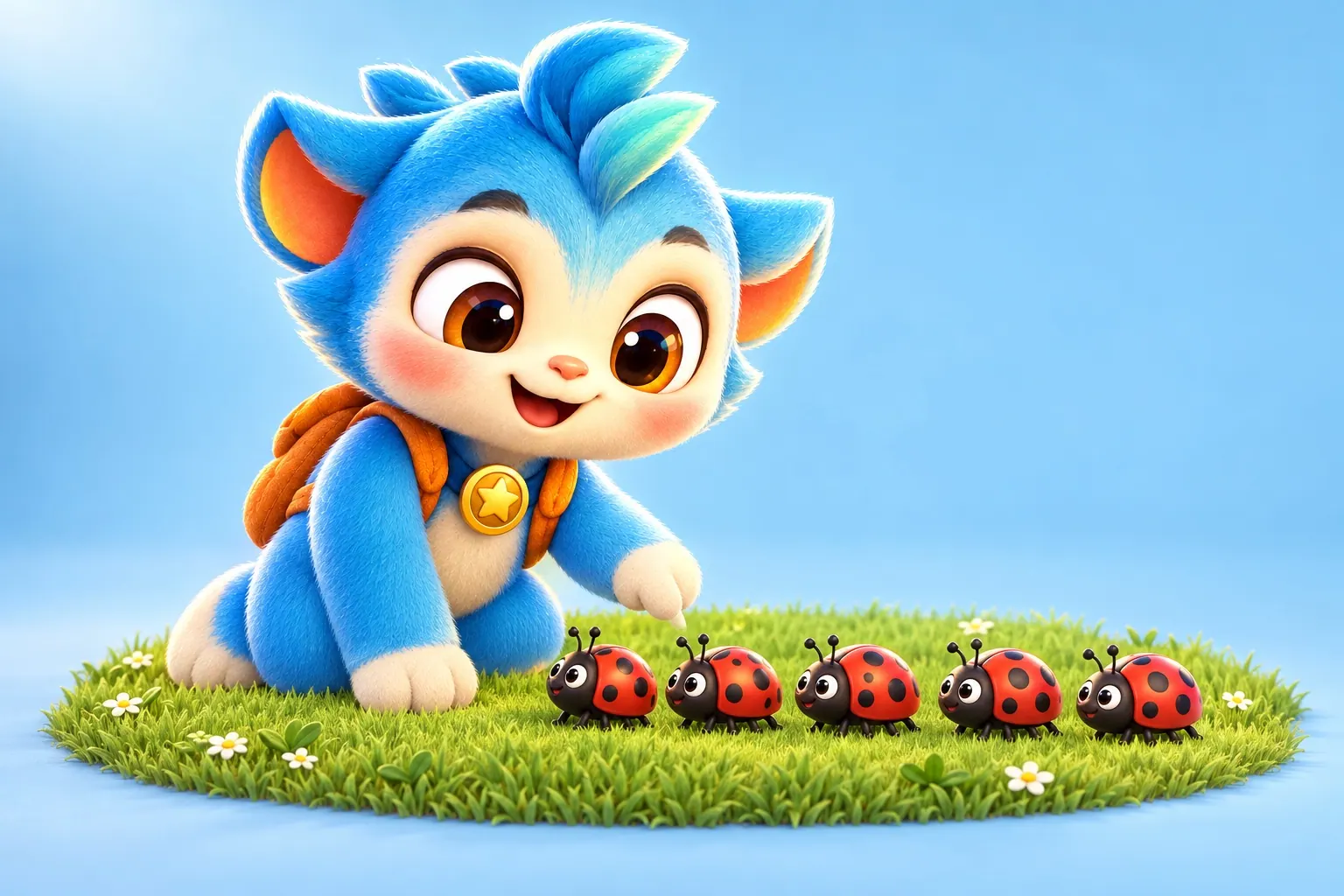
Our free Count and Tap game asks your child to tap each object once: ladybugs, apples, stars and more. A number appears on each one as it is counted, and tapping it again does not count it twice. Then your child picks how many there are from three choices. It has three modes, To 5, To 10 and To 20, so you can start small; in To 20 the objects sit in rows of five. For more, see the free preschool math games.
To see where this skill sits in a school year, the preschool curriculum page lists “Matching one to one” under counting to 5, and the kindergarten page lists counting objects in rows and scattered. Our guide on how to teach a child to count covers the steps around this one, and math games for kids at home has more things to play.
Quick answers
What is one to one correspondence in simple words?
It means saying one number word for each object you count, and counting each object only once. If you count four pennies, you point to a penny and say one, point to a second penny and say two, and so on, with none skipped and none counted twice.
Is one to one correspondence the same as knowing how many?
No. Pairing one word with one object is the counting itself. Knowing that the last number said tells how many is a second idea, called cardinality. Head Start lists them together, and the IES practice guide says children typically do not see at first that the point of counting is to find the total.
At what age do children count objects one to one?
Head Start's framework places the start between ages 3 and 4 (36 to 48 months), when a child begins to point to or move objects while counting small groups in a line. By 60 months, it expects children to pair one number word with each object up to at least 10. Children vary, so treat these ages as a guide, not a deadline.
Why does my child say the numbers faster than they touch the objects?
Reciting the numbers often comes first, the IES guide notes, and matching them to objects can be a challenging step. Slow the count down, count a group of three or four, and touch or move one object for each word. If you are worried about your child's counting, talk to your child's teacher or doctor.
How do I help my child count objects that are scattered?
Start with a line, then spread the objects out a little at a time. Sliding each counted object to the other side of a plate shows which ones are done. The US kindergarten standards ask for up to 20 objects in a line and up to 10 scattered.
Related
Count and Tap
Tap each bug once to count it, then say how many.
- Ages 3–6
- Counting to 20
- One-to-one counting
Sources
- Common Core State Standards for Mathematics, Kindergarten: Counting and Cardinality (K.CC), National Governors Association Center for Best Practices and Council of Chief State School Officers. www.thecorestandards.org
- Head Start Early Learning Outcomes Framework: Ages Birth to Five (2015), Mathematics Development, US Department of Health and Human Services, Administration for Children and Families, Office of Head Start. headstart.gov
- Teaching Math to Young Children (practice guide), US Institute of Education Sciences, What Works Clearinghouse. ies.ed.gov
Keep reading
How to teach a child to count: 6 steps for ages 3 to 5
Counting is more than saying numbers in order. Six steps with household objects that take a child from reciting to counting a group and saying how many.
Subitizing: how to help kids see how many at a glance
Subitizing means seeing how many without counting. Learn the two kinds, why dice and dot patterns work, and how to practice with fingers and ten frames.
Greater than less than: how to teach the symbols to kids
Greater than, less than and equal to start with comparing objects. Steps for teaching the > and < symbols, and what the alligator trick can and can't do.