
Teaching math
Subitizing: how to help kids see how many at a glance

In this guide
Subitizing means seeing how many objects there are at a glance, without counting. A child who looks at three crackers and says “three” right away is subitizing. Start practice with one to three objects. Dice, dot cards, fingers and ten frames then help children see bigger numbers as groups.
What are the two kinds of subitizing?
The researcher Douglas Clements describes two kinds in a 1999 article for teachers.
- Perceptual subitizing is recognizing a number without using other math. A child “sees 3” without any counting. Clements, citing earlier research, writes that two-year-olds show this ability clearly.
- Conceptual subitizing is seeing a number as a group made of smaller groups. Someone who looks at a domino with eight dots and just knows it is eight sees two groups of four and, at the same time, one group of eight.
Clements says conceptual subitizing must be learned. Dot patterns, fingers and ten frames help children learn it.
In the UK the word is spelled “subitising.” It means the same thing.
How many can a child see at a glance?
Start with one, two and three. The IES practice guide on teaching math to young children, written for preschool, pre-K and kindergarten, says to first give children chances to name the total of small collections of one to three items without needing to count them. Its example of a child ready for the next step is one who sees one, two or three stickers and says the number right away.
Bigger numbers come later. Looking across older studies, Clements concludes that most preschool children seem unable to subitize conceptually and count one by one instead. By school age they can learn to, although first graders’ limit for scattered arrangements is about four or five items. So if your six-year-old counts a scattered handful of seven one by one, that fits what Clements describes. He also notes that the way objects are arranged changes how hard they are to see at a glance.
Why do dice and dot patterns work?
In the studies Clements reviews, children usually find rectangular arrangements easiest, then rows, then circles, then scattered dots, from the early grades through college. When he plays his quick-image game with kindergartners, he starts with rectangular and dice patterns, because research shows these are easiest for young children at first. Dice patterns also look the same every time. Two dots sit on a diagonal, three on a diagonal, four in the corners and five as four corners with one in the middle.
Clements suggests that sets for beginners should be plain: simple dots or squares rather than pictures of animals, a regular arrangement, and strong contrast between the dots and the card. The same guidelines say dots in a line are easiest for preschoolers and rectangles for older children, so with a three- or four-year-old, line the dots up before you try dice patterns.
How do ten frames and fingers help?
A ten frame is a box with two rows of five squares. Put counters in it from the left of the top row. Seven counters fill the top row and two squares of the bottom row, so a child can see “5 and 2” without counting seven times. Clements says children can use ten frames to picture addition, and that finger patterns also help, especially with number pairs that make 10.
Fingers work the same way. Holding up four fingers on one hand and three on the other shows 4 and 3 as two groups. Ask children to show you numbers on their fingers in more than one way, such as 5 as one full hand or as 3 and 2. Our guide to number bonds to 10 uses these pictures once children are ready to name the pairs.
How do I practice subitizing at home?
Most of these use things you already have at home.
- At snack time, give your child two crackers, and ask how many they have. The IES guide suggests this kind of everyday question. Then try one and three.
- Play the hiding game from the IES guide. Put one to three identical objects on a mat for a few seconds, cover them with a cloth or a bowl, and ask, “How many am I hiding?” Lift the cover and count together to check. If this is hard, the guide suggests asking how many before you cover the objects, then asking again once they are hidden.
- Mix the objects. Once your child is sure of “three yellow blocks,” try three different things, such as a block, a spoon and a toy car. Say, “These are three too.” The IES guide says that calling both kinds of group “three” helps children build a more general idea of the number.
- Name what is not the number. Show four toys and say, “That’s four toys, not three.” The IES panel suggests this contrast to help children understand exactly what “three” means.
- Make dot cards. Draw 1 to 6 dots on index cards with a marker, in dice patterns. Show a card for a moment, hide it behind your back, and ask how many. Clements calls this a quick image game. You don’t need a timer.
- Later, show a card and ask for one more. “I saw 4. What is one more?”
Keep sessions short and relaxed. If your child counts, let them count. Afterward, show the card again and say the pattern: “Four. Two on top, two on the bottom.”
Small things such as counters, buttons, beads and stickers are a choking risk: keep them away from children under 3, and stay close when older children use them. Dot cards drawn with a marker avoid small pieces altogether.
What do the standards say about it?
The US Common Core kindergarten counting standards do not use the word subitizing. K.CC.B.5 asks children to “count to answer ‘how many?’ questions” about as many as 20 things in a line, a rectangular array or a circle, or as many as 10 things in a scattered configuration. K.CC.B.4b adds that the number of objects is the same however they are arranged. The IES hiding game practices that too: show the same objects again in a new arrangement, and the answer does not change. Clements describes perceptual subitizing as one way children make the units they count.
The IES practice guide says more. Its first recommendation is to teach number and operations through a developmental progression, and the example progression it gives starts with subitizing small collections. Our preschool curriculum page lists seeing 1 to 3 and then 1 to 5 at a glance for ages 4 to 5.
Which games help with subitizing?
Count and Tap leaves its objects (bugs, apples, stars and more) on the screen: your child taps each one once, then picks how many there are from three choices. In the To 5 mode there are one to five objects. Before your child taps, ask, “How many do you see?” Let them guess, then tap to check: the numbers on the objects show whether the guess was right. More free games for this age are on the preschool games page. For the counting that comes alongside, see how to teach a child to count, and for what comes next, what math a 5-year-old should know.
If your child finds small numbers very hard over many weeks of calm practice, talk to their teacher or doctor.
Quick answers
Is subitizing the same as counting?
No. Subitizing means knowing how many at a glance, and counting means giving each object one number word. The two work together: in the IES practice guide's hiding game, children count to check their quick answer.
At what age can children subitize?
It depends on the kind. Clements, citing earlier research, writes that two-year-olds show perceptual subitizing clearly. The IES guide, which covers preschool, pre-K and kindergarten, suggests practice with one to three objects first. Seeing bigger numbers as groups takes longer: Clements concludes that most preschoolers seem unable to do it yet. Children vary, so treat ages as a guide.
Is it cheating if my child counts the dots?
No. Counting is the right skill for larger or scattered groups, and Clements notes that most preschoolers count such groups one by one. Keep playing the quick-look games alongside counting, and let your child count to check after they guess.
What is subitising?
It is the UK spelling of subitizing. The word means the same thing: seeing how many objects there are without counting them one by one.
Do school standards require subitizing?
Not by name. The US Common Core kindergarten counting standards do not use the word; they ask children to count to answer "how many?" questions, including up to 10 things scattered about. The IES practice guide for ages 3 to 6 does recommend giving children practice with it.
Related
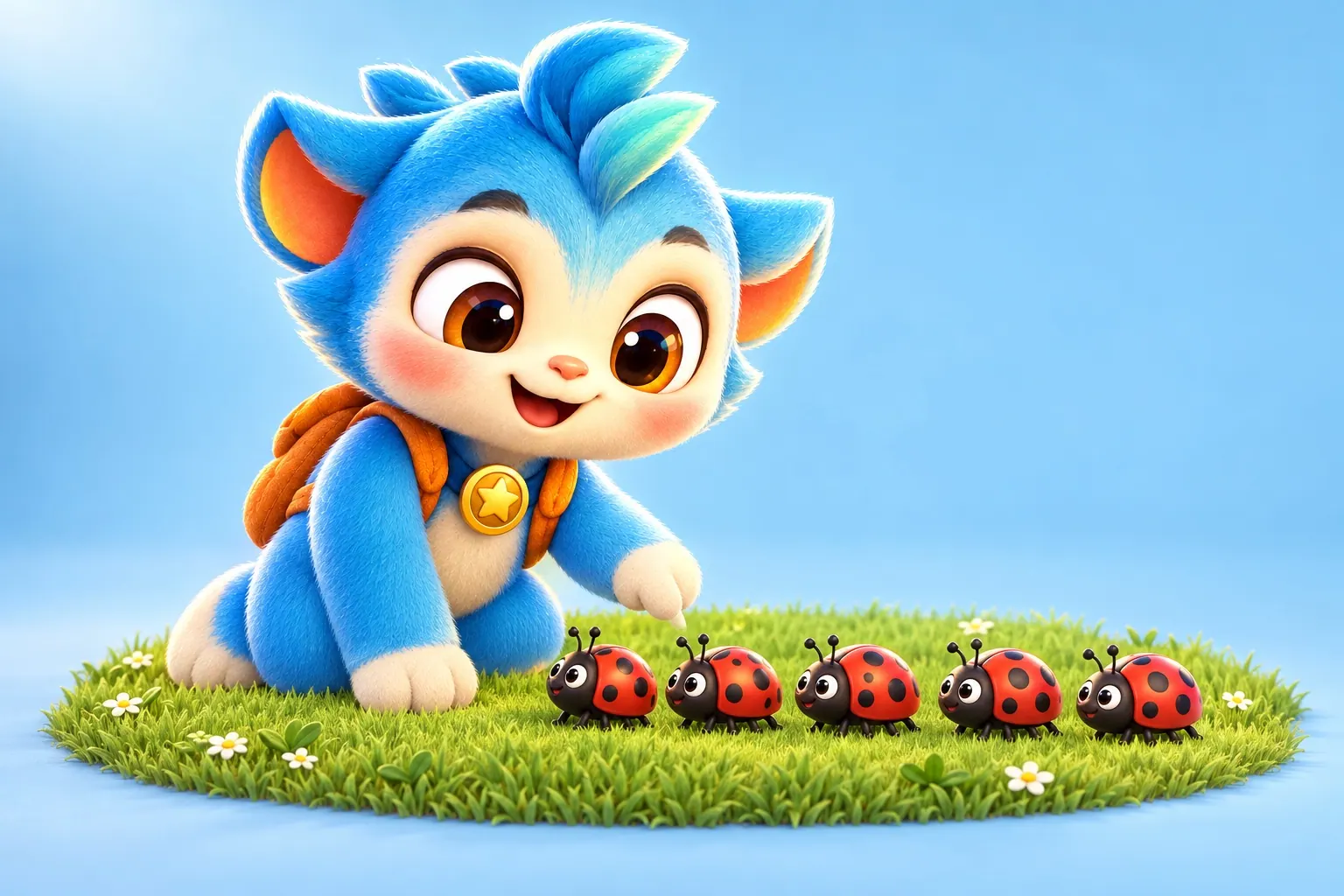
Count and Tap
Tap each bug once to count it, then say how many.
- Ages 3–6
- Counting to 20
- One-to-one counting
Sources
- Teaching Math to Young Children (practice guide), US Institute of Education Sciences, What Works Clearinghouse. ies.ed.gov
- Subitizing: What Is It? Why Teach It? (Teaching Children Mathematics, March 1999), Douglas H. Clements, National Council of Teachers of Mathematics (school district copy, printed with NCTM's permission). cpb-us-w2.wpmucdn.com
- Common Core State Standards for Mathematics, Kindergarten: Counting and Cardinality (K.CC), National Governors Association Center for Best Practices and Council of Chief State School Officers. www.thecorestandards.org
Keep reading

Greater than less than: how to teach the symbols to kids
Greater than, less than and equal to start with comparing objects. Steps for teaching the > and < symbols, and what the alligator trick can and can't do.
Even and odd numbers: the pairing trick for kids
A number is even if objects split into pairs with none left over. Teach even and odd numbers with pairs first, then skip counting and the last-digit rule.
Fact family in math: what it means and how to teach it at home
A fact family is the set of addition and subtraction facts that use the same three numbers. See fact triangles, examples and how they make subtraction easier.