
Teaching math
Even and odd numbers: the pairing trick for kids
In this guide
A number is even if that many objects can be put into pairs with none left over, and odd if one object is left alone. The last digit tells even and odd numbers apart: even numbers end in 0, 2, 4, 6 or 8, and odd numbers end in 1, 3, 5, 7 or 9. Teach pairing first.
What are even and odd numbers?
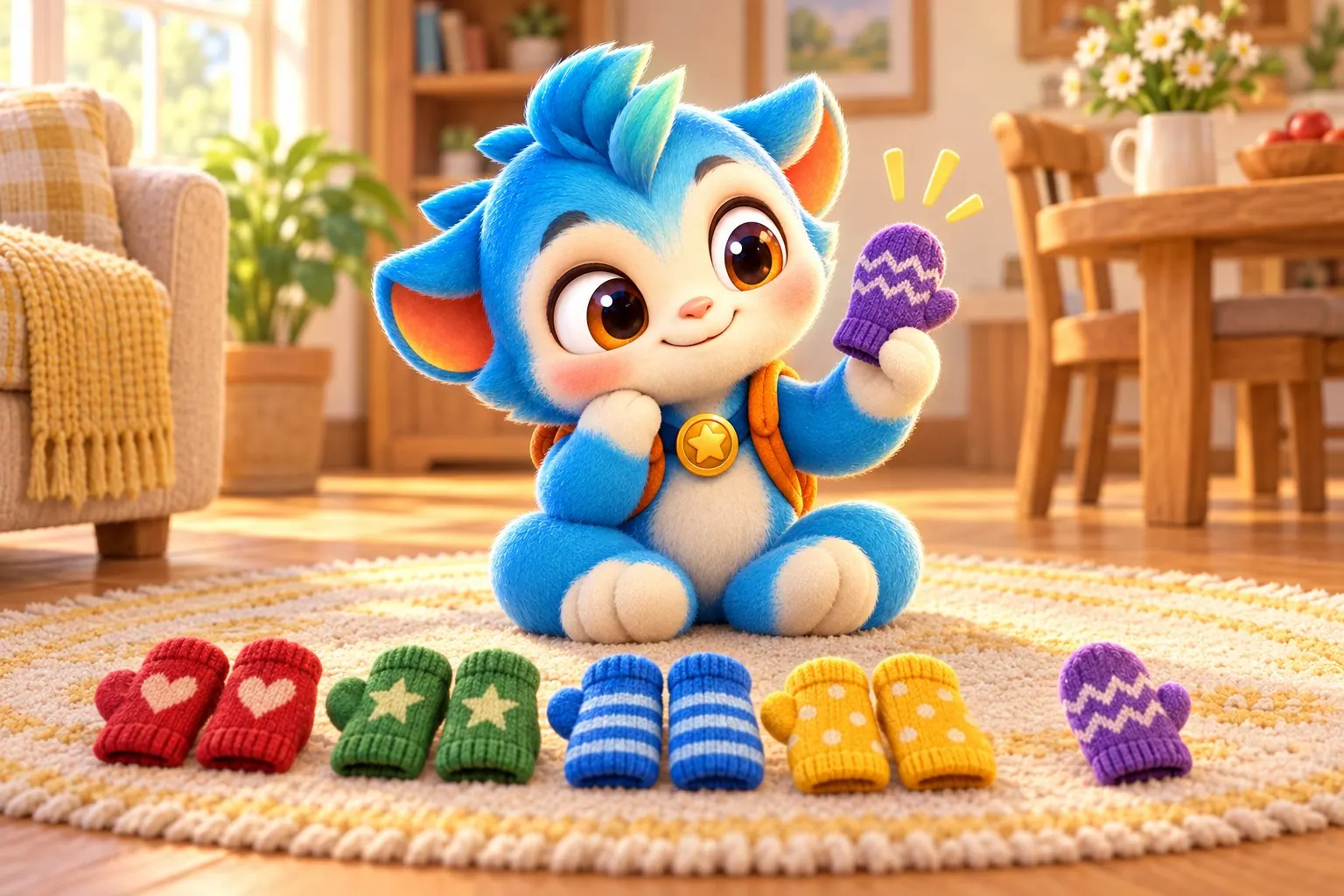
Take 6 socks and match them into pairs. You get 3 pairs and nothing is left, so 6 is even. Take 7 socks. You get 3 pairs and one sock without a partner, so 7 is odd.
Every whole number is one or the other, and the numbers alternate when you count: 1 is odd, 2 is even, 3 is odd, 4 is even, and so on. Zero counts as even, because there is nothing left over.
In the US Common Core standards this is a Grade 2 topic. Children are asked to decide whether a group of up to 20 objects has an odd or even number of members, “e.g., by pairing objects or counting them by 2s,” and to write an equation that shows an even number as the sum of two equal addends, such as 8 = 4 + 4. The IES practice guide on teaching math to young children, which covers ages 3 to 6, recommends teaching number “using a developmental progression.” We follow that idea here with older children: objects first, then talk about pairs, then the digits and the rule.
How do I teach it with pairs?
Use things that come in pairs or can be paired up: socks, shoes, mittens, spoons, or small toys. Keep tiny items away from children under 3.
- Count out 8 blocks. Ask your child to make pairs by putting two blocks side by side.
- Count the pairs and ask, “Is anything left over?” Nothing is, so say, “Eight is even.”
- Take away one block. Pair again. One is left over. “Seven is odd.”
- Try other numbers up to 20. Let your child predict first: “Do you think 9 will have a leftover?”
- Write what you found: 8 is even, 7 is odd.
A second way is to draw a line down the middle of a sheet of paper and deal objects onto each side, one for the left and one for the right. If both sides match, the number is even. If one side has an extra, it is odd.
For a snack version, share a handful of crackers or grapes between two plates (cut grapes lengthwise for young children). Ask “Can we make it fair?” If both plates get the same number with none left over, the number was even.
How do skip counting and equations help?
Counting by 2s lands only on even numbers: 2, 4, 6, 8, 10. Start at 1 and count by 2s and you get the odd numbers: 1, 3, 5, 7, 9. Hop along a number line drawn in chalk, say each number you land on, and ask your child what they notice.
Equations make the pairing visible in symbols. If a number is even, it can be written as two equal groups: 6 = 3 + 3, 10 = 5 + 5, 14 = 7 + 7. If it is odd, it cannot: no whole number added to itself makes 7. Our guide to how to teach addition covers adding the same number twice, which is called doubles, and doubles are exactly the even numbers.
Pairing depends on steady counting. If your child still loses track when counting objects, start with our guide on how to teach a child to count.
How can I tell if a big number is even or odd?
Look at the last digit only. If it is 0, 2, 4, 6 or 8, the number is even. If it is 1, 3, 5, 7 or 9, it is odd. So 346 is even, 1,257 is odd, and 40 is even.
The rule works because ten is five pairs, so every ten, hundred and thousand is made of whole pairs. Only the ones can leave a single object behind, so the last digit decides and the first digit does not: 38 is even, though it starts with an odd 3.
To practice, write a few numbers on cards and sort them into two piles, even and odd. Ask your child to say the rule aloud while sorting: “Ends in 4, so even.” Our guide to place value explains why the ones digit stands apart from the tens.
What happens when you add even and odd numbers?
This is a good puzzle once the basics are easy. Use counters and pairs to find out.
- Make 4 and 6 from counters and push them together. Pair them all up. The total, 10, is even.
- Make 3 (one pair and a single) and 5 (two pairs and a single). Push them together. The two singles pair up with each other, so the total, 8, is even.
- Make 4 and 3. There is still one single, so the total, 7, is odd.
Ask your child to guess before each trial: “Even plus odd, what do you think?” Write down what you find. After a few tries, put the rule into words together: even plus even gives even, odd plus odd gives even, and even plus odd gives odd.
How do even and odd numbers lead to later math?
In the US Grade 2 standards, even and odd numbers sit in a group of standards headed “Work with equal groups of objects to gain foundations for multiplication.” The next standard there is about arrays: objects in rows and columns, up to 5 rows and 5 columns, with the total written as a sum of equal addends.
Even numbers fit this neatly. Any even number of counters can go into 2 equal rows: 8 is 2 rows of 4, or 4 + 4. With 7, one row is always longer. Ask your child to build 10 in 2 rows, then in 5 rows of 2, and say the sum each time: 5 + 5, then 2 + 2 + 2 + 2 + 2. A muffin tin or an egg carton makes the rows easy to see.
What mix-ups should I expect?
Watch for these mix-ups, and try the fix next to each one.
- Mixing up everyday meanings. “Even” can also mean flat or level, and “odd” can mean strange. Tie the math meaning to pairs each time: “Odd means one is left over.”
- Reading the wrong digit. For 38 or 52, make sure your child looks at the last digit.
- Counting the pairs instead of the objects. Three pairs of socks is 6 socks. Ask “How many socks in all?” after finding the pairs.
- Leaving out 0. If it comes up, ask “Is there anything left over?”
If your child finds pairing very hard after weeks of calm practice with objects, talk to their teacher.
Which game helps?
Equal Groups is a free game on this site where children put cookies into equal groups on plates. Sharing the same number onto every plate is close kin to pairing, and it builds the idea that a number can split into equal parts. Sit beside your child as you play. When a round has two plates, ask how many cookies there are in all and whether that number is even.
On this site, the first grade curriculum page lists odd and even in a unit on counting in 2s, 5s and 10s. The second grade page covers numbers to 1,000, where the last-digit rule saves a lot of pairing.
Quick answers
Is 0 an even number?
Yes. With no objects there is nothing left over after pairing, so 0 is even. You can leave it until the pairing idea is solid.
What grade learns even and odd numbers?
Grade 2, in the US Common Core standards. Children are asked to tell whether a group of up to 20 objects has an odd or even number of members, for example by pairing the objects or counting by 2s. Pairing socks or shoes at home is a fine start before then.
How can I tell if a big number is even or odd?
Look at the last digit only. If it is 0, 2, 4, 6 or 8 the number is even. If it is 1, 3, 5, 7 or 9 the number is odd. The tens and hundreds are always made of whole pairs, so they never change the answer.
What happens when you add two odd numbers?
The total is even. Each odd number has one object left over, and the two leftovers pair up with each other. Try it with 3 + 5 = 8 using counters.
Do I need to teach this before my child counts by 2s?
No. Pairing objects and counting by 2s support each other, so you can do both in the same week. Counting by 2s lands on the even numbers 2, 4, 6, 8 and so on.
Related

Sources
- Common Core State Standards for Mathematics, Grade 2: Operations and Algebraic Thinking (2.OA), National Governors Association Center for Best Practices and Council of Chief State School Officers. www.thecorestandards.org
- Teaching Math to Young Children (practice guide), US Institute of Education Sciences, What Works Clearinghouse. ies.ed.gov
Keep reading

Skip counting by 2s, 5s and 10s: a parent's guide with a chart
Skip counting means counting in equal jumps. Learn how to teach counting by 10s, 5s and 2s, how to use a hundred chart, and how it leads to multiplication.
Fact family in math: what it means and how to teach it at home
A fact family is the set of addition and subtraction facts that use the same three numbers. See fact triangles, examples and how they make subtraction easier.
Greater than less than: how to teach the symbols to kids
Greater than, less than and equal to start with comparing objects. Steps for teaching the > and < symbols, and what the alligator trick can and can't do.