
Teaching math
Skip counting by 2s, 5s and 10s: a parent's guide with a chart

In this guide
Skip counting is counting forward in equal jumps, such as 10, 20, 30 or 5, 10, 15, instead of one number at a time. Teach tens first, then fives with hands and nickels, then twos with pairs. A hundred chart makes the patterns easy to see, and the same equal jumps lead on to multiplication.
Why count in 10s first?
Tens make a good first jump because you can hear the pattern: ten, twenty, thirty. The written numbers all end in 0. The US kindergarten standards ask children to “count to 100 by ones and by tens,” so this is where US schools begin too.
Make it physical, because a child sees what a jump of 10 is when there are 10 things in it.
- Lay out 10 pennies, spoons or craft sticks in a pile. Make 5 or 6 piles.
- Touch the first pile and say “10.” Touch the second and say “20.” Keep going to the last pile.
- Ask, “How many do we have in all?” Count in tens to find out.
- Next time, hide one pile under a cup and ask, “What comes after 40?”
Bundles of 10 craft sticks tied with a rubber band work well. Keep small items away from children under three.
Your child might skip a decade or say “twenty-ten” while learning the names. Go back to the piles and say each one slowly.
How do I teach counting by 5s?
Five is the number of fingers on a hand, so start there. Ask your child to hold up one hand and count the fingers: 1, 2, 3, 4, 5. Then bring out the second hand and say, “Two hands is 10.” Count hands: 5, 10, 15, 20.
- Place a hand flat on the table and say “5.”
- Add a second hand and say “10,” then a third and say “15.” You can use a few family members’ hands, or trace your child’s hand on paper several times.
- Say the numbers rhythmically, and clap on each jump.
- Practice the counts forward to 50 before going to 100.
Nickels are the next step. A nickel is worth 5 cents, so a pile of nickels counts by fives. Line them up, touch each one and say “5, 10, 15, 20.” Add a dime, worth 10 cents, to the line and your child will see where fives and tens meet. Our free Coin Shop game uses coin values this way.
The clock gives a second use. The minute hand moves 5 minutes for each number it passes, so counting by 5s is how children read minutes. See how to read a clock for that connection.
How do I teach counting by 2s?
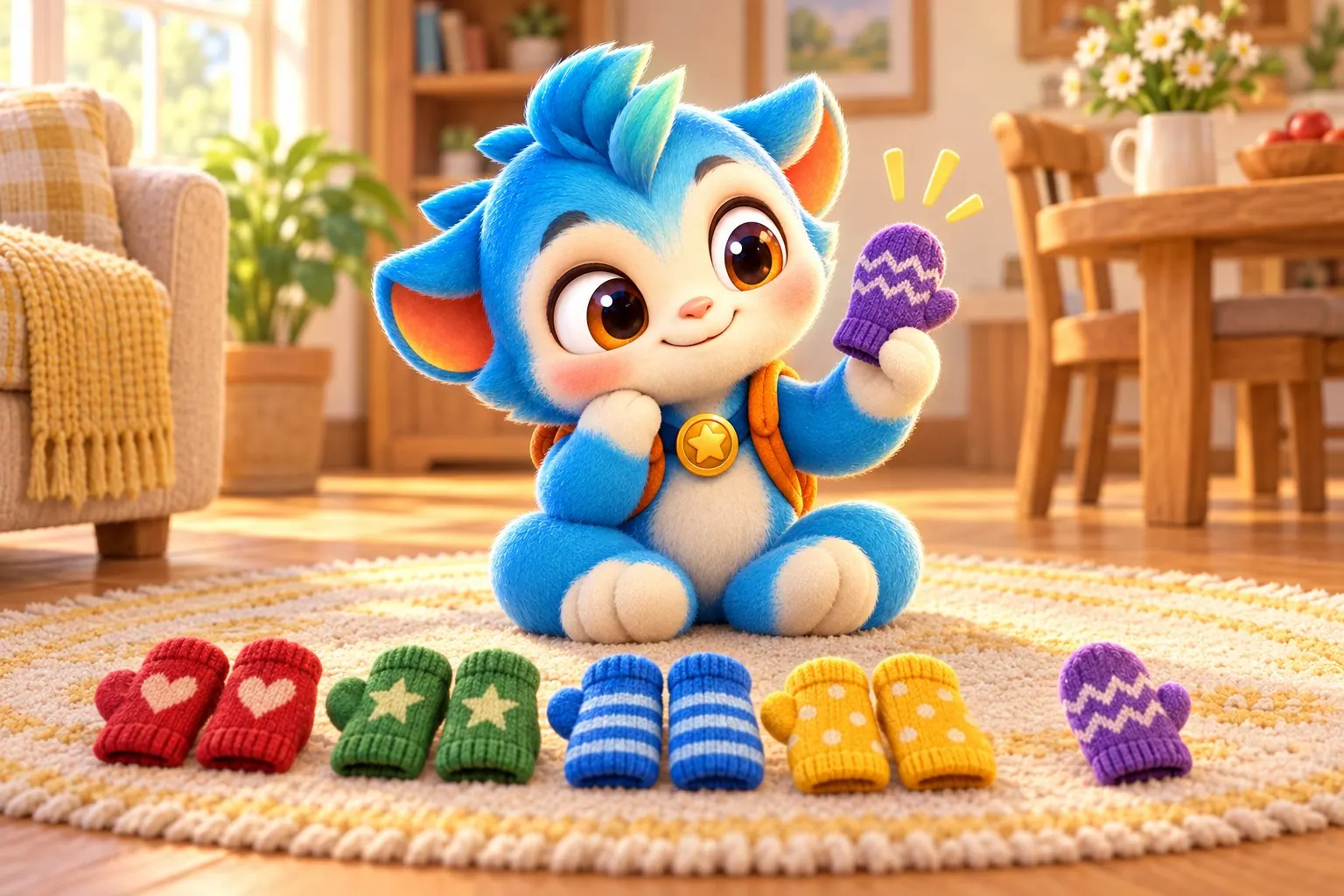
Pairs make twos easy to see. Shoes come in pairs, socks come in pairs, and so do gloves, mittens and eyes.
- Line up four pairs of socks. Touch the first pair and say “2,” the second “4,” then “6,” then “8.”
- Ask, “How many socks in all?” Say “8.”
- Add another pair and carry on: 10.
- Count back down the line too. On the stairs, say the next number on every second step.
Twos lead to even numbers. The US Grade 2 standards ask children to “determine whether a group of objects (up to 20) has an odd or even number of members,” for example “by pairing objects or counting them by 2s,” and to write an equation that expresses an even number as the sum of two equal addends, such as 8 = 4 + 4. When you count by 2s you say 2, 4, 6, 8, and all of them are even. An odd number has one object left over with no partner.
England’s national curriculum names counting in 2s outright. Year 1 asks children to “count in multiples of 2s, 5s and 10s,” and Year 2 to “count in steps of 2, 3, and 5 from 0, and in 10s from any number, forward and backward.” The US Grade 2 skip-counting standard is “Count within 1000; skip-count by 5s, 10s, and 100s.”
How does a hundred chart help?
A hundred chart is a grid of the numbers 1 to 100 in ten rows of ten. Skip counting makes patterns on it that a child can see. Print one or copy it onto a sheet of paper in ten rows. Then color the numbers as you count, or use our free interactive 100 chart and tap them on a screen.
- Counting by 10s colors the whole last column: 10, 20, 30 and on to 100.
- Counting by 5s colors the fifth column and the last column. The numbers end in 5 or 0.
- Counting by 2s colors every other square, which makes stripes down the chart, one column in two. The numbers end in 0, 2, 4, 6 or 8.
Ask your child, “What do you notice?” Let them find the pattern in their own words before you name it. Then ask them to predict: “If we keep counting by 5s, will we land on 65?” Check it on the chart.
Say the numbers aloud while you point, so the sound goes with the picture, and count with objects too. Later, cover the chart and see how far your child can go without it.
What if my child loses their place?
In the middle of a long count, a child has to hold two things at once: the size of the jump and the number they are on. When the place slips, try this.
- Go back to objects or the chart.
- Count the first few numbers together. Then let your child take over.
- Stop on a number and ask, “What comes next?” so they do not need to start at the beginning each time.
- Keep counts short at first. Count to 30 by tens or 5s before going on.
A tune or a rhythm can help. Keep it light and stop when it stops being fun.
Where does skip counting lead?
Skip counting is an early step toward multiplication. If you count 5, 10, 15, 20 for four hands, you have found 4 groups of 5, or 4 x 5 = 20. The US Grade 3 standards ask children to “interpret products of whole numbers, e.g., interpret 5 × 7 as the total number of objects in 5 groups of 7 objects each.”
Try this at home. Put cookies on 4 plates, 5 on each plate. Ask, “How can we count them all?” Counting by 5s is faster than counting by 1s, and it is also the idea behind a times table.
Which games help with skip counting?
- Coin Shop: pay with coins and give change. A row of nickels counts by 5s and a row of dimes by 10s.
- Equal Groups: share cookies onto plates so each plate has the same, then count the groups.
Our first grade and second grade curriculum pages show what skip counting leads to: odd and even numbers, arrays and the first multiplication facts. If counting from 1 is still shaky, start with our guide to how to teach a child to count.
If your child finds skip counting very hard after many weeks of calm practice, talk to their teacher.
Quick answers
Which should I teach first: 2s, 5s or 10s?
Start with 10s. The pattern is easy to hear and see, and the US kindergarten standards ask children to count to 100 by tens. Move to 5s next, then 2s.
What grade learns skip counting?
In the US, kindergarten counts by tens (K.CC.A.1) and Grade 2 skip-counts by 5s, 10s and 100s (2.NBT.A.2). Counting by 2s comes in through odd and even numbers in Grade 2 (2.OA.C.3), which suggests pairing objects or counting them by 2s. In England, Year 1 asks children to count in multiples of 2s, 5s and 10s, and Year 2 asks for steps of 2, 3 and 5 from 0 and 10s from any number.
My child loses their place in the middle. What should I do?
Go back to objects or a chart and count in groups again. Counting aloud while touching each group helps keep the place. You can also stop on a number and ask what comes next, so your child does not have to start over.
How does skip counting help with multiplication?
Counting 5, 10, 15, 20 for four hands is the same as 4 groups of 5, which is 4 x 5 = 20. The US Grade 3 standards describe a product as the total in a number of equal groups.
Related

Coin Shop
Run the shop: pay with coins and give the right change.
- Ages 6–8
- Counting coins
- Paying an exact amount

Sources
- Common Core State Standards for Mathematics, Kindergarten: Counting and Cardinality (K.CC), National Governors Association Center for Best Practices and Council of Chief State School Officers. www.thecorestandards.org
- Common Core State Standards for Mathematics, Grade 2: Number and Operations in Base Ten (2.NBT), National Governors Association Center for Best Practices and Council of Chief State School Officers. www.thecorestandards.org
- Common Core State Standards for Mathematics, Grade 2: Operations and Algebraic Thinking (2.OA), National Governors Association Center for Best Practices and Council of Chief State School Officers. www.thecorestandards.org
- Common Core State Standards for Mathematics, Grade 3: Operations and Algebraic Thinking (3.OA), National Governors Association Center for Best Practices and Council of Chief State School Officers. www.thecorestandards.org
- National curriculum in England: mathematics programmes of study, UK Department for Education. www.gov.uk
Keep reading
Even and odd numbers: the pairing trick for kids
A number is even if objects split into pairs with none left over. Teach even and odd numbers with pairs first, then skip counting and the last-digit rule.
Fact family in math: what it means and how to teach it at home
A fact family is the set of addition and subtraction facts that use the same three numbers. See fact triangles, examples and how they make subtraction easier.

Greater than less than: how to teach the symbols to kids
Greater than, less than and equal to start with comparing objects. Steps for teaching the > and < symbols, and what the alligator trick can and can't do.