
Games and activities
Math card games for kids: 7 games with one ordinary deck
In this guide
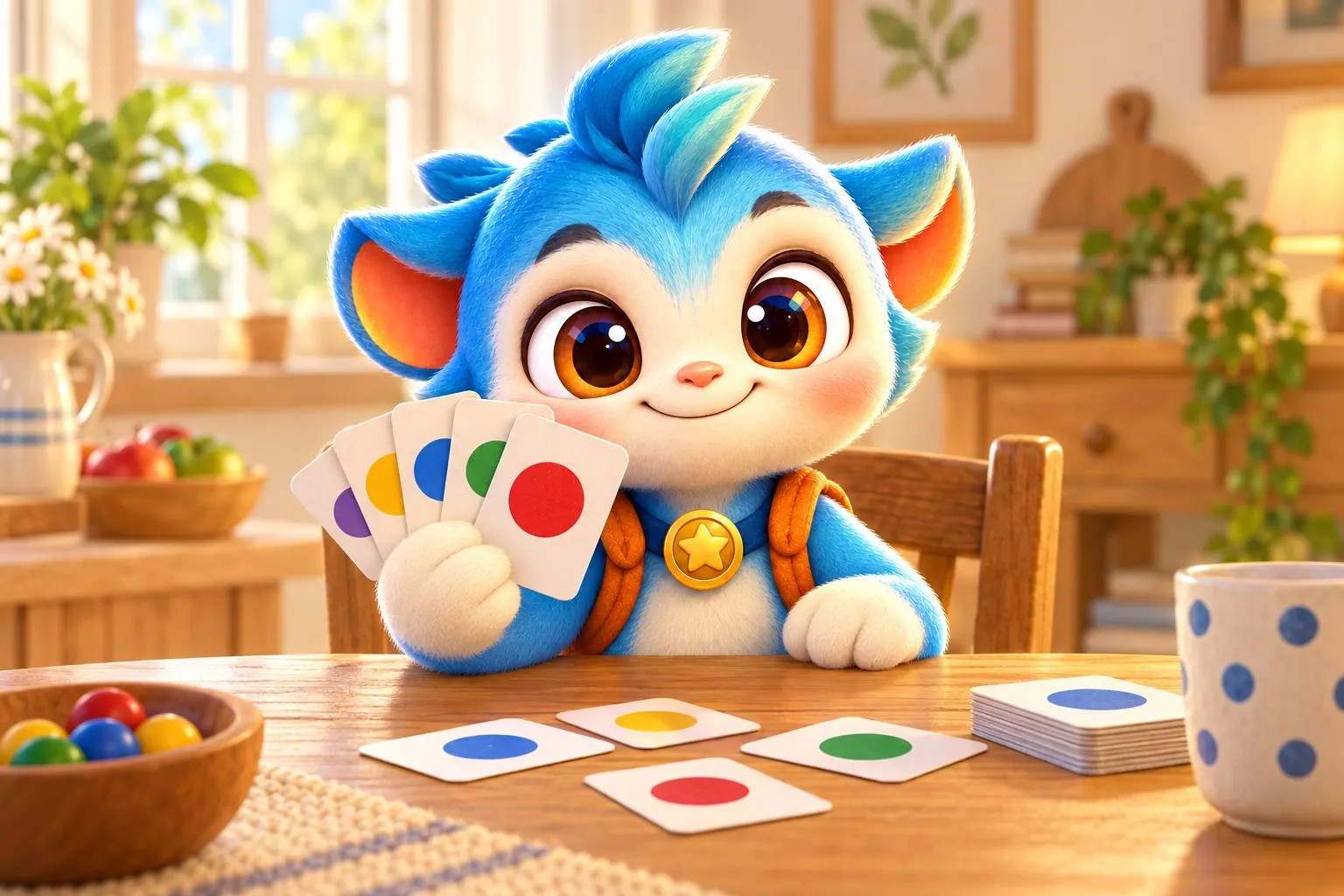
Math card games turn a regular deck into number practice. Take out the face cards, count the ace as 1, and you can play seven games that practice number order, comparing, making ten and adding. Each has short rules, a suggested age and the math it practices.
How do I set up a deck for math games?
Take the face cards (jack, queen, king) and the jokers out. What is left is ace through 10, in four suits. The ace counts as 1. For the games with a ten target, take the 10s out too, so every card is a number from 1 to 9.
Young children can count the symbols on a card instead of reading the number. That keeps a 4-year-old in the game, and reading the numeral can come later. The US kindergarten standards ask children to compare two numbers from 1 to 10 written as numerals, and also to compare groups of objects “by using matching and counting strategies,” which is what counting the symbols does.
If a child under 3 is nearby, keep the deck out of reach. Toddlers chew cards, and a chewed or torn corner is small enough to choke on.
Which math card games can you play with one deck?
These seven run from number order for 4-year-olds to adding within 20 for 8-year-olds. All of them work with two players, such as a parent and a child.
1. Missing card (ages 4 to 5)
This game practices number order. You need the ace through 10 of one suit.
- Lay the ten cards in a row in order, from ace to 10. Say the numbers together as you point.
- Ask your child to close their eyes. Turn one card face down.
- Your child opens their eyes and says which number is hidden. Turn the card over to check.
- Swap roles, and play as many rounds as your child enjoys.
To make it easier, use only ace to 5. To make it harder, shuffle the cards and let your child put them back in order first. To find the hidden number, your child may count forward from a card in the row, which is kindergarten standard K.CC.A.2: count forward “beginning from a given number within the known sequence (instead of having to begin at 1).”
2. Matching pairs (ages 4 to 6)
The IES guide describes a memory game in which children match a card showing a numeral and dots with a card showing a picture of that many objects. With a deck, you match the same number in two suits.
- Pick six numbers, such as 1 to 6. Take the two red cards of each number.
- Shuffle the twelve cards and lay them face down in rows.
- Take turns turning over two cards. Say the number on each card out loud as you flip it.
- If the numbers match, keep the pair and go again. If not, turn them back face down, and the next player has a turn.
- When all pairs are found, the player with more pairs wins.
Naming each card as it turns over adds number-reading practice to the memory work.
3. War with a twist: how many more? (ages 5 to 6)
In ordinary war, the higher card wins. The twist is to say by how much.
- Deal the deck, ace to 10, equally between two players. Keep your cards in a face-down pile.
- Both players flip their top card at the same time.
- The higher card wins both. The winner says how many more: “7 is 3 more than 4.” Put won cards in a separate pile.
- If the cards match, each player flips one more, and the higher card takes all the flipped cards. If those match too, flip again. If the piles run out during a match, each player takes back their own cards.
- When the face-down piles run out, count your won cards. The player with more wins.
For a younger child, skip the “how many more” step and just ask who has more. Comparing two numbers from 1 to 10 is kindergarten standard K.CC.C.7. Saying how many more is a comparing problem, one of the situations the Grade 1 standards list for adding and subtracting within 20.
4. Make ten pairs (ages 5 to 7)
Remove the 10s. You need the cards from ace to 9.
- Shuffle and lay out 12 cards face up, in rows. Keep the rest in a face-down pile.
- Take turns choosing two cards that add up to 10, such as 3 and 7 or 5 and 5. Say the sum, keep the pair, and fill the two spaces from the pile.
- If no two cards on the table make 10, add one more card from the pile and look again.
- The game ends when every card is in a pair. The player with more pairs wins.
The pairs are 1 and 9, 2 and 8, 3 and 7, 4 and 6, and 5 and 5. Kindergarten standard K.OA.A.4 asks children to find “the number that makes 10 when added to the given number” for any number from 1 to 9. Our guide to number bonds to 10 explains the pairs. If making ten is new, start with a target of 5 and cards from ace to 4.
5. Go Fish for tens (ages 5 to 7)
In this Go Fish, you collect pairs that make ten. Remove the 10s.
- Deal five cards to each player and spread the rest face down in the middle.
- Put down any pairs in your hand that make 10.
- On your turn, pick a card in your hand and ask another player for its partner: “I have a 4. Do you have a 6?”
- If they have it, they hand it over. Put the pair down in front of you and ask again.
- If they do not, they say “Go fish.” Draw a card from the middle, and put down a pair if it makes one. Then the next player has a turn. If your hand is empty at the start of your turn, draw a card first; if the middle is empty too, skip your turn.
- The game ends when every card is in a pair. The player with the most pairs wins.
A 5 pairs with another 5, so if you hold a 5, ask for a 5. It is a good moment to say “Five and five make ten.”
6. Addition war (ages 6 to 8)
Each player turns over two cards and adds them, and the bigger total wins.
- Deal the deck, ace to 10, equally between two players, in face-down piles.
- Each player flips two cards and says the total out loud: “6 and 7 is 13.”
- The higher total takes all four cards. Put won cards in a separate pile.
- If the totals match, each player flips two more, and the higher total takes all the flipped cards. If the piles run out during a match, each player takes back their own cards.
- When the face-down piles run out, count your won cards. The player with more wins.
Older children can count on from the bigger card. The Grade 1 standards describe this as a way to relate counting to addition: “counting on 2 to add 2.” They also list “making ten” as a strategy, so for 8 and 6, a child might think 8 + 2 + 4 = 10 + 4 = 14, which the standards use as their own example.
The 10s are in the deck here, so totals go up to 20. Grade 2 asks children to “fluently add and subtract within 20 using mental strategies,” and to know all sums of two one-digit numbers from memory by the end of the year.
7. Exactly 20 (ages 6 to 8)
Two or more players can play. You need paper to keep each running total.
- Shuffle the deck, ace to 10, into one face-down pile. Every player’s total starts at 0.
- On your turn, flip the top card and add it to your total. Say it out loud: “I have 9. I flip a 4. That’s 13.”
- If a card would take you past 20, your total stays the same.
- Put every flipped card at the bottom of the pile, so the cards keep coming around.
- The first player to land on exactly 20 wins.
For ages 5 to 6, play to 10 with cards from ace to 5. Counting on is the strategy to practice, and your child can work out how much they need: “I’m at 13. I need a 7.”
Which game for which age?
- Ages 4 to 5: missing card, matching pairs, and war with only ace to 5.
- Ages 5 to 6: war with a twist, make ten pairs, and Go Fish for tens. For a target of 5, use only ace to 4.
- Ages 6 to 8: addition war, exactly 20, and make ten pairs or Go Fish with a target of 15. Use only the cards from 5 to 10; the pairs are 5 and 10, 6 and 9, and 7 and 8.
Ages are a guide. Try a game with the numbers your child already knows well, and move up from there.
What does the research say about math card games?
The IES practice guide on teaching math to young children recommends using games “to teach math concepts and skills and to give children practice in applying them.” It says games can supply “repeated practice that is not boring” and give children and teachers a chance to discuss strategies. The guide covers preschool through kindergarten. Games are one part of its recommendation to make time for math every day, and it rates the evidence for that recommendation as minimal: its panel could not point to research showing a positive effect on achievement. So treat card games as one enjoyable way to practice.
Which free games go with these?
Our free Make Ten Match game uses the same idea as the make ten pairs game: tap two cards that add to 10, with Make 5 and Make 20 boards too. Number Bonds asks children to join touching tiles that add up to target numbers. For more by grade, see the free kindergarten math games and first grade math games. The kindergarten curriculum page lists what a year usually covers.
For games that use dice, snacks and walks, see math games for kids at home. For race tracks, dominoes and dice games, see math board games.
Quick answers
What are good math card games for kindergarten?
Start with the missing card game, matching pairs and war with a twist. They use numbers up to 10 and ask children to put numbers in order, match them and say which is more. Make ten pairs fits kindergarten too: the US standards ask children to find the number that makes 10 with any number from 1 to 9.
Do I take the face cards out of the deck?
Yes, for these games. Keep the aces to 10, or the aces to 9 for the make ten games. Count the ace as 1. Put the face cards, jokers and any 10s that a game does not use back in the box.
How long should a card game last?
Five to ten minutes is plenty for ages 4 to 6, and a little longer for older children. Stop while they still want to play, and play again another day.
How do I make a card game easier for a 4-year-old?
Use only the cards from ace to 5, and let your child count the symbols on each card instead of reading the number. Lay cards side by side so they can match them one to one.
Do card games really help with math?
They give repeated practice with numbers and a reason to talk about how an answer was found. The IES practice guide for preschool and kindergarten recommends games for math practice, but it rates the evidence for that recommendation as minimal: its panel could not point to research showing a positive effect on achievement.
Related
Make Ten Match
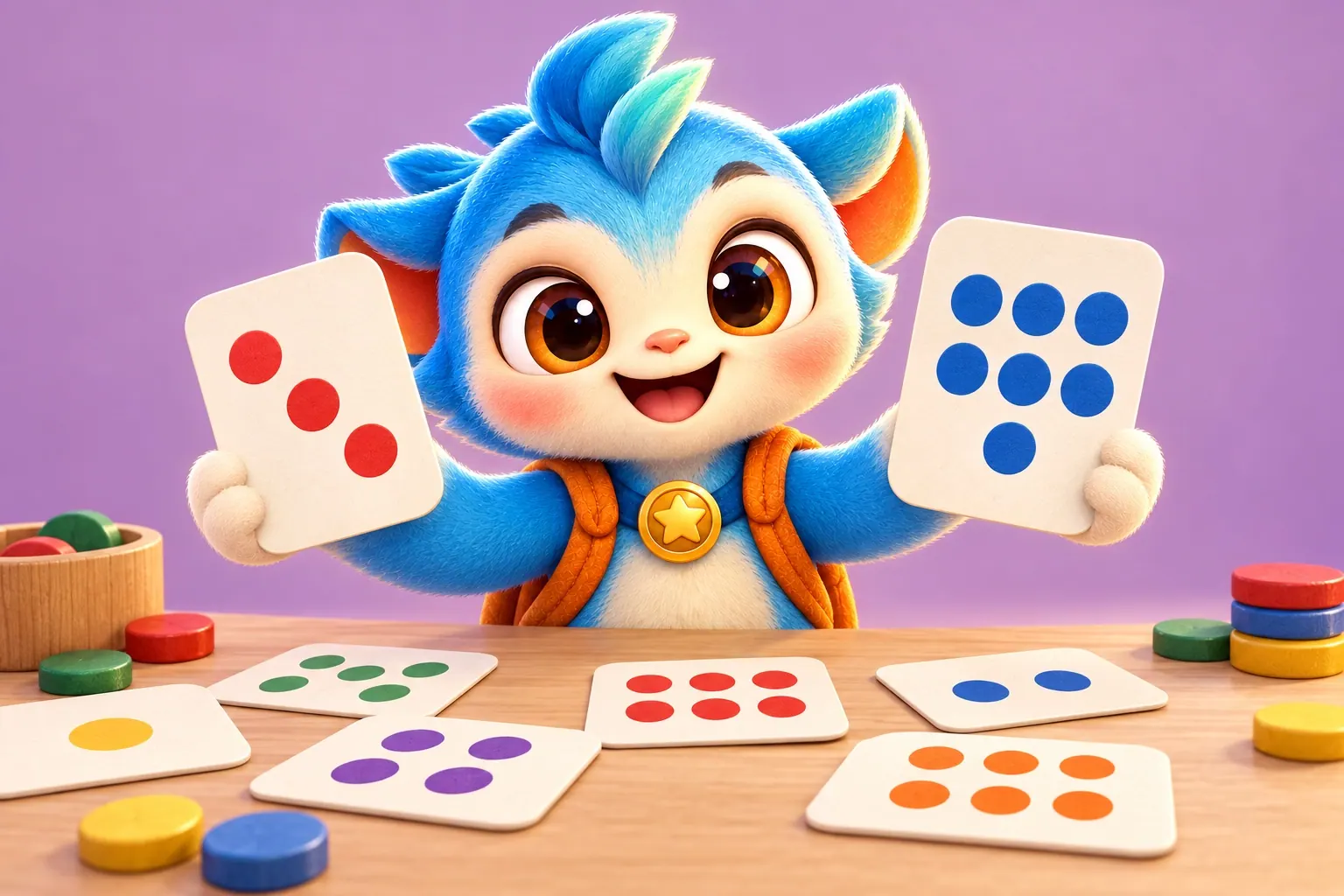
Find two cards that add up to 10 and match them.
- Ages 5–7
- Pairs that make 10
- Bonds to 5 and 20

Sources
- Teaching Math to Young Children (practice guide), US Institute of Education Sciences, What Works Clearinghouse. ies.ed.gov
- Common Core State Standards for Mathematics, Kindergarten: Counting and Cardinality (K.CC), National Governors Association Center for Best Practices and Council of Chief State School Officers. www.thecorestandards.org
- Common Core State Standards for Mathematics, Kindergarten: Operations and Algebraic Thinking (K.OA), National Governors Association Center for Best Practices and Council of Chief State School Officers. www.thecorestandards.org
- Common Core State Standards for Mathematics, Grade 1: Operations and Algebraic Thinking (1.OA), National Governors Association Center for Best Practices and Council of Chief State School Officers. www.thecorestandards.org
- Common Core State Standards for Mathematics, Grade 2: Operations and Algebraic Thinking (2.OA), National Governors Association Center for Best Practices and Council of Chief State School Officers. www.thecorestandards.org
Keep reading
Math board games for kids: what to play at ages 3 to 8
Math board games for kids, by age: race tracks, dominoes, sowing games, Shut the Box and dice games, plus how to make your own number track at home.
12 math games for kids at home, with no worksheets
Twelve math games for kids at home using cards, dice, the kitchen and a walk. No worksheets, no special supplies, plus free online games to try.
Number bonds to 10: what they are and 7 ways to practice
Number bonds to 10 are the pairs that make 10, like 3 and 7. See what they are, why making ten matters, and seven ways to practice at home.