
Teaching math
How to teach subtraction so it makes sense to your child

In this guide
- Step 1: How do I start with taking away?
- Step 2: How does a number line help?
- Step 3: What is finding the difference?
- Step 4: What does “think addition” mean?
- What are the common mix-ups?
- How often should we practice?
- What about subtraction on paper?
- Which words should I use?
- Which games help with subtraction?
- Quick answers
Teach subtraction in four steps, which are also the main subtraction strategies: take objects away and count what is left, count back on a number line, find the difference between two groups, and then think addition (“what plus 3 makes 7?”). Use real things first and written equations last.
Step 1: How do I start with taking away?
Put 6 crackers on a plate. Say “You eat 2.” Remove two and ask “How many are left?” Count the rest together: 4.
The US kindergarten standards list many ways to show subtraction: objects, fingers, drawings, claps, acting out a story, and equations. Stories help: “5 ducks were swimming. 2 flew away.” Let your child act it out with toys.
Keep numbers within 5 at first, then within 10. The standards list fluent adding and subtracting within 5 as a kindergarten goal.
When your child is steady, write it once: 6 − 2 = 4. Read it aloud as “6 take away 2 is 4.”
Step 2: How does a number line help?
Draw a line with numbers 0 to 10, or use a ruler. To find 8 − 3, put a finger on 8 and hop back three times: 7, 6, 5. You land on 5.
Two things to watch:
- The start number is not counted as a hop. Say “8, then 7, 6, 5” or say the hops aloud: “one, two, three.”
- Counting back works well for taking away 1, 2 or 3. For larger amounts it gets tiring and mistakes creep in. Step 4 often works better for those.
For practice, try Hop Back, a free game where a frog hops back along a number line.
Step 3: What is finding the difference?
Some questions are not about removing anything. “I have 7 stickers and you have 4. How many more do I have?”
Line the stickers up in two rows, matching one to one. The 3 extra stickers in the longer row are the difference. You can also count on from 4 up to 7: 5, 6, 7 is three steps.
Because nothing disappears, this can feel harder than take-away. Use two real rows and let your child match the items.
A story helps here too: “You have 7 stickers and I have 4. If we both put one down at a time, who runs out first? How many are left over?” Matching the stickers in pairs is the same as subtracting 4 from 7.
Step 4: What does “think addition” mean?
The Grade 1 standards ask children to understand subtraction as an unknown-addend problem. In plain words: 10 − 7 asks “What do I add to 7 to get 10?”
- Say the subtraction as a missing-number question: “7 plus what makes 10?”
- Count up from 7: 8, 9, 10. That was three counts.
- Check by adding: 7 + 3 = 10.
This works well for bigger take-aways, and it links to number bonds. If your child knows 7 and 3 make 10, they know 10 − 7 and 10 − 3. See number bonds to 10 and how to teach addition for the matching steps.
The same standards say first graders should add and subtract within 20, and be fluent within 10. The standard lists strategies like these as the way there, including counting on and using addition to subtract, so give them time.
Worked example: 9 − 6. A child can take away 6 from 9 objects and count the 3 left. They can count back 6 from 9 (a lot of hops). Or they can think “6 plus what makes 9?” and count up 7, 8, 9. All three give 3. The last is quickest here because the numbers are close. Showing your child all three, and asking which feels easiest, helps them pick a method that fits the numbers.
A rule of thumb: when the number being taken away is small (1, 2 or 3), count back. When the two numbers are close together, count up from the smaller one. Otherwise, use objects or a drawing.
What are the common mix-ups?
- Adding instead of taking away. The child sees “5 and 2” and says 7. Go back to objects: put 5 down, take 2 away, and look.
- Counting the starting number as a hop. On the number line, 8 − 3 comes out as 6. Hop three times and say where you land.
- Thinking order does not matter. 3 − 5 is not the same as 5 − 3. Addition can be turned around; subtraction cannot. Show it with objects.
- Losing track while counting back. Keep fingers up to count the hops, one finger per hop.
- Not seeing “how many more” as subtraction. Draw it as two rows, then tell the story in words.
If a mistake keeps happening, move to smaller numbers and real objects for a few days. If you are worried, talk to your child’s teacher.
How often should we practice?
Aim for a few minutes a day with real things. The IES practice guide for early math recommends teaching number and operations in a developmental progression, which means going step by step and moving on when your child is ready. If a step feels shaky, stay there a little longer. Mixing the four steps in the same week is fine once each has been tried once.
What about subtraction on paper?
Writing comes last. Once your child can tell a take-away story and show it with objects, let them draw it: circles for the objects, a cross through the ones taken away. Then write the equation under the drawing. The kindergarten standards list drawings, sounds and acting out as ways to show subtraction, with equations as one option among several, so a child who draws instead of writes is on track.
Borrowing, also called regrouping, comes later with two-digit numbers. Taking away within 20 is plenty for now.
Which words should I use?
Use the words your child hears at school: take away, minus, subtract, left, difference, how many more. Say them in everyday talk (“You have 5 grapes, minus 2 for me”) so the signs on paper later sound familiar. In England, children of these ages are in Year 1 and Year 2, and “number bonds” is the usual term there. You may also hear “part-part-whole” or “fact families” for the ways numbers split and join. Whichever words your child’s teacher uses are the ones to copy at home.
Which games help with subtraction?
- Hop Back for counting back on a number line.
- River Race for two-digit adding and subtracting, once the single-digit step is easy.
These are free in the browser, with no timer. To see what comes next, read the topic lists for Kindergarten math and First grade math. More free kindergarten math games and first grade math games are on their own pages.
Quick answers
At what age do children learn subtraction?
In US kindergarten (ages 5 to 6), children add and subtract within 10 using objects and drawings. In first grade they work within 20 and aim for fluency within 10. Simple take-away with a few objects can start earlier, at home or in preschool.
Why does my child answer 5 minus 2 with 7?
After a lot of adding, a child may add any two numbers they see. Put out 5 objects, remove 2 and ask what is left. Let the objects show that the answer gets smaller.
Should my child memorize subtraction facts?
Fluency within 10 is a first-grade goal in the US standards. The standard pairs it with strategies such as counting on and using addition to subtract, so teach those first.
What is the difference between take away and finding the difference?
Take away starts with a group and removes some. Finding the difference compares two groups, such as 7 stickers and 4 stickers: how many more?
Related
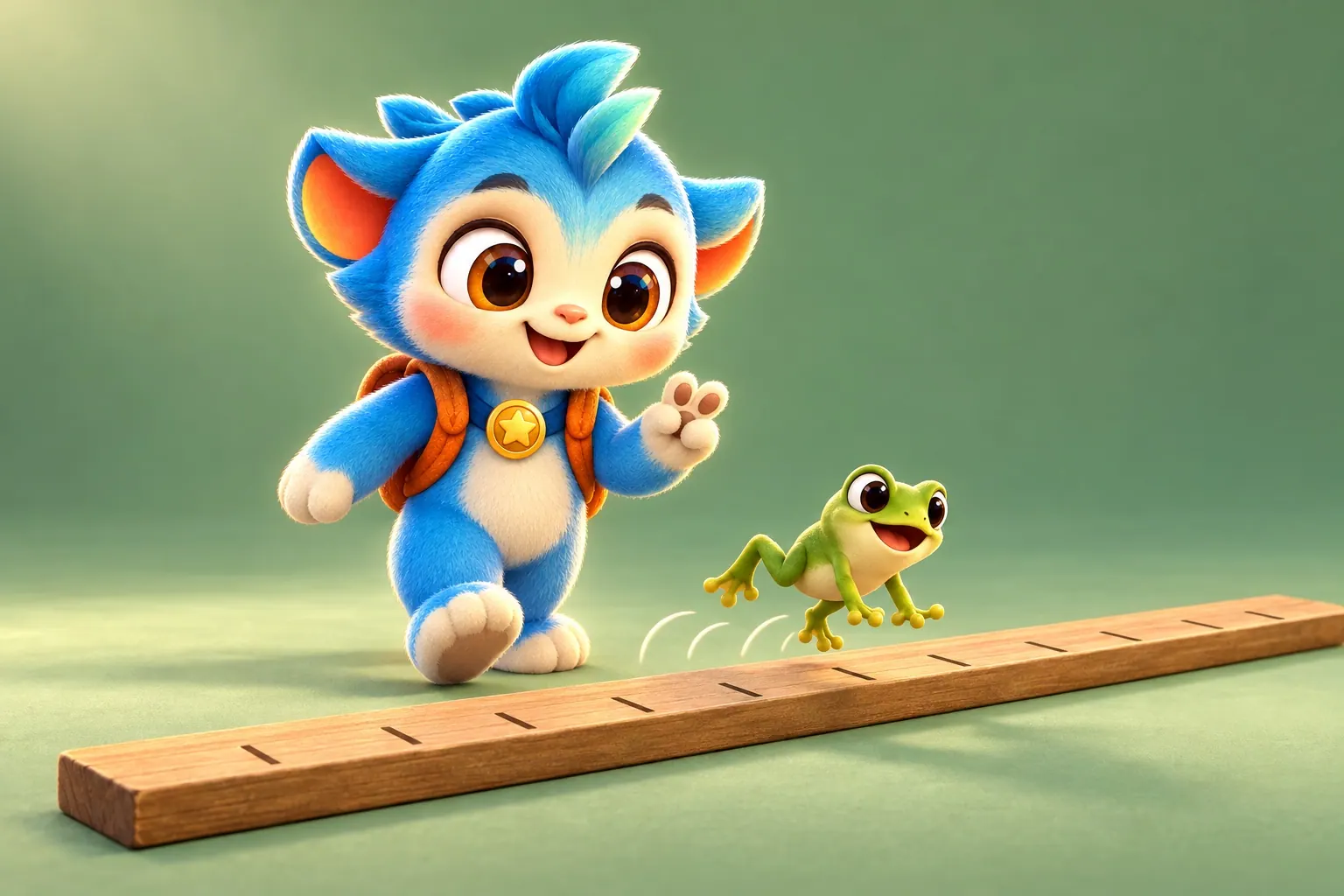
Hop Back
Hop back along the number line to find the answer.
- Ages 5–8
- Subtraction within 10 and 20
- Counting back on a number line

River Race
Paddle against Mathumo: each right answer moves your boat forward.
- Ages 6–8
- Two-digit addition
- Two-digit subtraction
Sources
- Common Core State Standards for Mathematics: Kindergarten, Operations and Algebraic Thinking, National Governors Association Center for Best Practices and Council of Chief State School Officers. www.thecorestandards.org
- Common Core State Standards for Mathematics: Grade 1, Operations and Algebraic Thinking, National Governors Association Center for Best Practices and Council of Chief State School Officers. www.thecorestandards.org
- Teaching Math to Young Children (practice guide), US Institute of Education Sciences, What Works Clearinghouse. ies.ed.gov
Keep reading

Greater than less than: how to teach the symbols to kids
Greater than, less than and equal to start with comparing objects. Steps for teaching the > and < symbols, and what the alligator trick can and can't do.

How to teach addition: from counting all to making ten
How to teach addition to kids in order: counting all, counting on, doubles, making ten, then fluency through play instead of timed drills.
Number bonds to 10: what they are and 7 ways to practice
Number bonds to 10 are the pairs that make 10, like 3 and 7. See what they are, why making ten matters, and seven ways to practice at home.